Vermont Soap Organics in the USA manufactures unique and natural body care products of benefit and value. They are also an example of how companies can contribute to positive social change. They emphasize wholeness in all departments within the company through communication, participation in the growth process, and responsibility among employees.
They commit to conducting their business in an environmentally conscious way and emphasize reuse and recycling, and perhaps most importantly for the environment; they use only natural base ingredients from sustainable sources in all their products.
Their products are certified according to the USDA organic food standard (USDA Organic) from Vermont Organic Farmers (VOF). Naturally, none of their products contain hidden animal ingredients, which is otherwise common in conventional soap.
What is Castile soap?
The word Castile in Vermont Soap Organics’ liquid Castile soaps is a reference to La Castilla – a region in central Spain historically significant in the history of soap making. In America, Castile means a soap made with olive oil, usually a liquid soap of olive oil and coconut oil.
But always check your ingredients – some companies add synthetic chemicals to their so-called Castile soap. Vermont Soap Organics does not. And all their ingredients are organic and carefully selected.
Their liquid Castile soap contains only saponified coconut oil, jojoba oil, olive oil, essential oil for fragrance (varies depending on which scent you buy), rosemary extract as a natural “preservative,” and aloe vera. Nothing else. And it is 100% organic.
Their foaming soap contains only aloe vera juice, saponified oils of coconut oil, shea butter, olive oil, sunflower oil, and jojoba oil, vegetable glycerin (glycerin), essential oil for fragrance, and rosemary extract as a natural “preservative.” And it is 100% organic.
How are their solid organic soaps made?
They are made using a modern version of a 250-year-old method. Certified organic oils of palm, coconut, olive, and palm kernel (all oils come from sustainable sources) are mixed at precise temperatures with an alkaline solution*.
*To make soap, you need an oil (which is an acid), an alkaline base, and water. Saponification is a reaction between these ingredients that results in the creation of soap. The oil and alkali undergo a structural change to form solid or liquid soap. For the alkaline base, it is traditional to use potassium hydroxide (INCI: potassium hydroxide) to make liquid soap and sodium hydroxide (INCI: sodium hydroxide) for solid soap.
The oils used in these organic, handmade soaps are carefully selected by the soap makers with regard to the character they give to the final soap. At Vermont Soap, they use the highest quality organic oil. They have experimented for a long time and arrived at the best blend of oils. Coconut oil creates batches of glycerin, makes good lather, and is very stable. Olive oil has natural antioxidants and makes the soap creamier. Each oil is used for a specific reason.
Note that oil and alkali must be in perfect balance to make the perfect soap; if you add too much of a specific oil, it won’t turn out well. This is a science that takes a long time to learn, and after several months of countless trials, Vermont Soap found the perfect recipe.
At Vermont Soap, the batch for the solid soaps is mixed for hours so that it thickens slowly. When ready, botanical and organic herbs, spices, and grains are added.
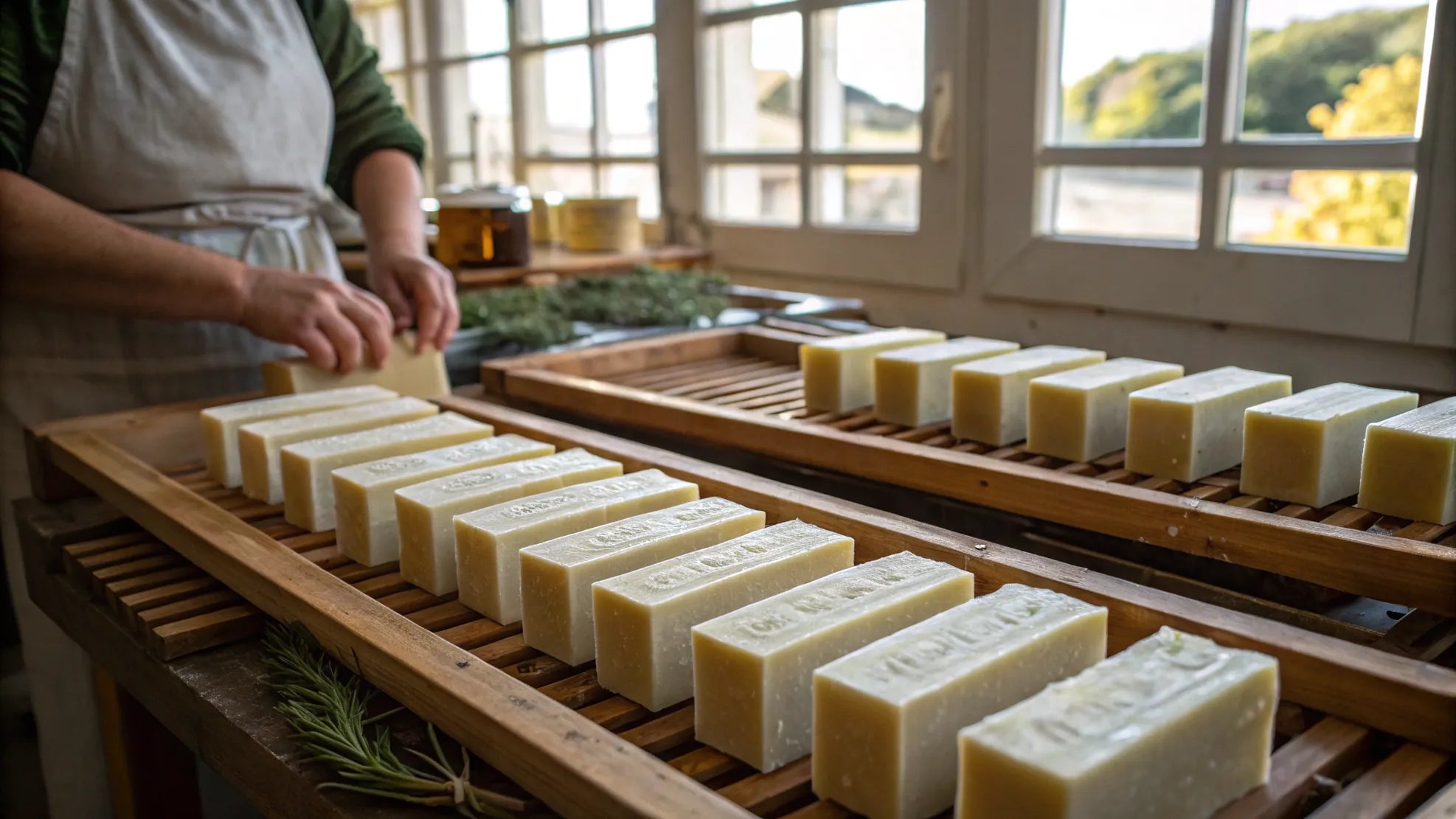
The batch is then poured into wooden molds and kept warm for about three days. As the soap solidifies, alkali salts begin to rise to the top like cream. Around the fourth day, the soap, now solid in block form, is removed from the molds, skimmed of all alkali salts, and cut into individual bars.
The soaps are then placed on custom oak and stainless steel drying racks and cured for about three weeks. This process produces the mildest and finest solid soap available.
Why should we buy natural soap?
These soaps last about twice as long as conventional ones and are very moisturizing and soothing for the skin. No measurable free alkali, i.e., residues of sodium hydroxide, remain when the soap is finished. This is part of the reason their soap is so mild.
Many modern conventional soaps are made in a mass-produced industrial way. They may, for example, use nut or beef tallow instead of oils. Conventional soaps often contain many synthetic additives, for example, to make the soap lather more. Glycerin is usually separated out to be sold elsewhere, whereas in natural soap it is stirred back in during soap production.
Problems in mass-produced soap making can include low-quality base ingredients, alcohol, synthetic colors and fragrances, and preservatives. The soap then lacks moisture fundamentally and tends to have alkali residues left in it, which will irritate the skin.
Oil and alkali must be balanced to make the perfect soap, as we mentioned earlier. Problems arise when alkali and oil do not chemically combine; alkali salts remain in the product. Excess alkali results in strong soap that dries out the skin. People with sensitive skin are especially prone to irritation from these types of soaps. Why all this? It costs less, takes less time, and yields greater profit.
We believe it is better to buy an organic soap that may cost more but lasts longer and benefits the skin, health, environment, and animals.
We are proud to sell Vermont Soap Organics! You can find their soaps here.