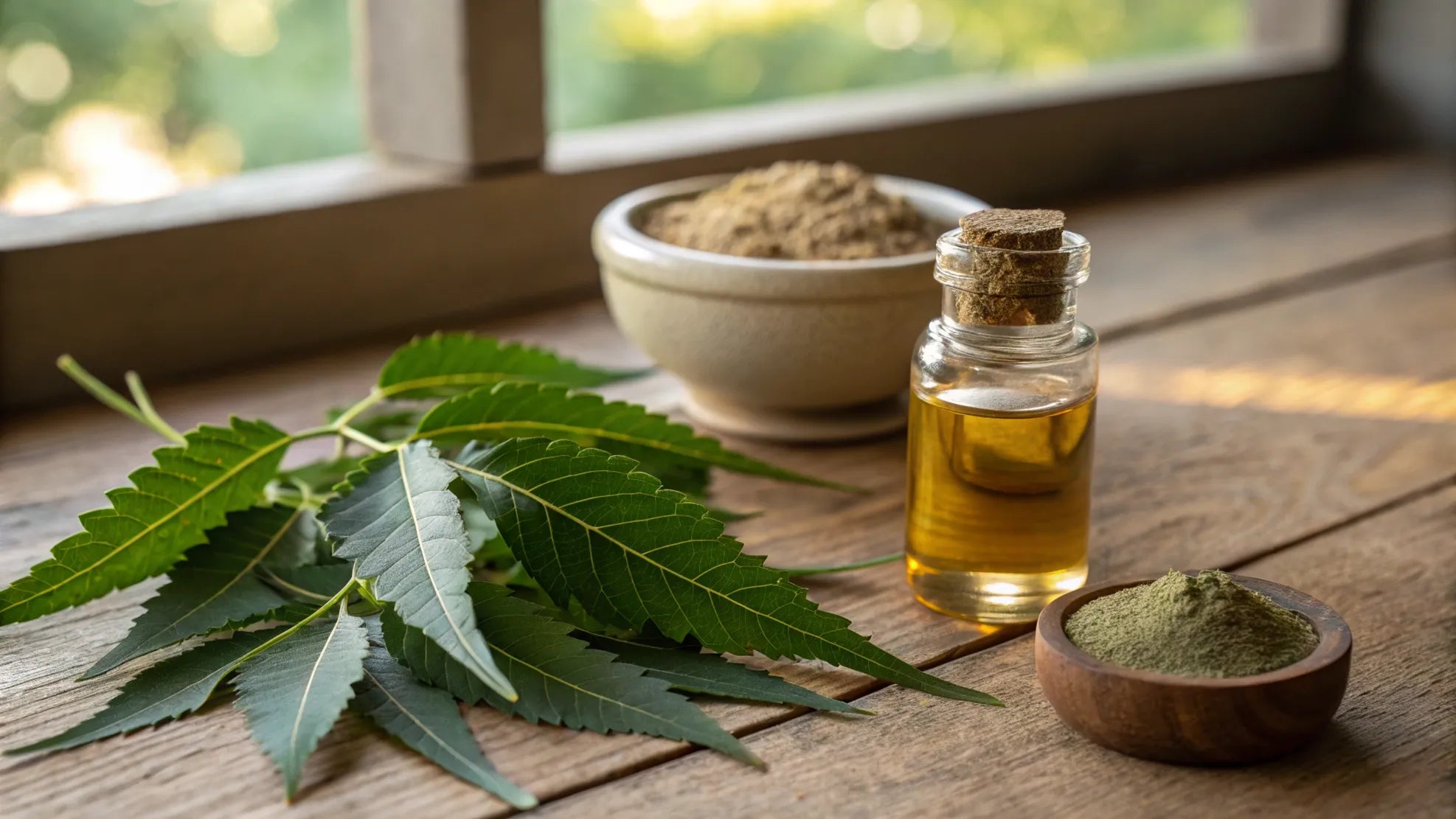
Due to neem’s many healing and protective qualities, the neem tree is called the “friend and protector” and the “miracle tree” throughout India.
In India, neem is considered the “village pharmacy” and is said to be a “universal remedy” with strong antibacterial and antiviral properties.
The magical leaves of the neem tree
Because neem contains more than 100 bioactive ingredients, it has long been used in Ayurvedic medicine.
Neem is an evergreen remarkably tolerant to both heat and drought. It can grow up to twenty meters in three years, is termite-resistant, and is often used in reforestation.
The leaves’ bitter taste comes from a range of complex compounds. Ayurvedic texts describe neem tree leaves as having an almost magical effect on skin and hair.
The neem tree’s leaves are known to help with eczema, acne, and small wounds. One traditional method involves mashing the leaves into a paste that is applied directly to wounds or skin rashes.
Neem also helps heal gums, prevent cavities, and is a welcome ingredient in natural toothpaste. Traditionally, people would break off a twig from the tree and chew on it.
Note: Neem oil is thick and can solidify at temperatures below 20 degrees Celsius. To make it more liquid, gently warm it in a water bath.
Note: Neem oil should not be used on small children, by pregnant women, or while breastfeeding.
3 ways to use neem powder
Having Neem powder at home can help with scalp itchiness, dandruff, acne, and eczema.
1. Hair Mask
Add a little water to the powder in a bowl to make a “paste.” Massage the paste into the scalp and leave it on for 5-20 minutes. Rinse thoroughly with water.
Note that neem has a strong scent but it does not transfer to your hair.
Then use a natural shampoo/shampoo soap/conditioner or just rinse with apple cider vinegar. Do what suits you best.
NOTE! Make sure not to get it in your mouth or eyes; it’s not harmful since Neem can be eaten, but it tastes really bad.
2. Face Mask
Neem is very effective against acne, impurities, and oily skin.
Take 1-2 teaspoons of Neem powder and add a little water to make a smooth batter.
Use it as is or mix with some rhassoul clay, honey, or plain yogurt to form a smooth paste.
Neem doesn’t smell particularly nice, but the scent does not linger in either hair or on the skin.
Avoid getting it in your mouth as it is extremely bitter and tastes very unpleasant.
You can also do a body pack for skin problems like eczema and fungal infections.
3. Body Scrub
Add Neem powder to your salt body scrub for skin issues such as eczema.
6 ways to use neem oil
Neem oil is extracted from the crushed seeds.
Just like the leaves, neem oil is used to treat skin and hair problems. The oil is especially helpful against dandruff, itching, and head lice.
Neem seed oil has a very beneficial effect on several types of skin problems and is used, among other things, for treating psoriasis, eczema, dry skin, and itching.
4. Against dandruff
Neem oil’s properties soothe and help the scalp achieve better balance.
Mix a few drops of neem oil into your shampoo or conditioner. Massage in and leave for a few minutes before rinsing out. Repeat regularly until the problem disappears.
There are also many ready-made shampoos and conditioners containing neem oil. For example, Pure Burdock & Neem Healthy Scalp Conditioner and Pure Burdock & Neem Healthy Scalp Shampoo.
5. Nail and foot fungus
Fungal infections on feet and nails can be stubborn. Neem oil’s antifungal properties can be helpful.
- Make a foot bath. Drop 5-10 drops into warm water and stir, sit for a while and relax. For deeper foot care, you can make an oil blend to rub on the feet afterward.
- Mix 70 ml thistle oil and 30 ml neem oil, add 10 drops of tea tree oil and blend in a bottle. Apply to the feet daily and let the mixture absorb into the skin. Store the mixture in a dark, cool place.
6. Minor wounds and mild skin irritations
- Mix neem oil with a more fluid vegetable oil such as thistle oil, melon oil, or camellia oil.
- Add about one tenth neem oil to the mixture.
- Then apply the mixture over the area.
If you want to mask the scent of neem oil and tolerate essential oils, you can add a couple of drops of any fragrance (2 drops/10 ml mixture).
7. Insect oil
Neem oil is not only good for the skin, insects also dislike the scent. That’s why you can use neem to keep insects away.
- Mix coconut oil with about one tenth neem oil.
- Apply to exposed areas of the body.
We humans usually don’t like the smell of neem either, so you can mix in essential oils to mask the scent. Add a couple of drops of essential oil (2 drops/10 ml mixture).
Insects also dislike lemongrass or lavender, so you can advantageously use them for extra protection.
8. Head lice
- Take two parts organic vegetable oil and one part neem oil, and feel free to add a few drops of tea tree and lavender essential oil.
- Make sure to oil your hair all the way to the tips. Be extra thorough at the nape and behind the ears.
- Leave in for at least 8 hours or overnight.
- Rinse out with an organic shampoo, preferably one with oils from lavender, tea tree, or rosemary that kills lice.
- Then use conditioner to dissolve the greasy oil.
- Then comb your hair thoroughly with a lice comb to remove dead lice and eggs.
- Repeat the entire process after one week.
- Comb your hair daily for 14 days with a lice comb and wash all bedding.
9. Pesticide
As a natural pesticide, neem oil can be used to prevent pests on plants both indoors and outdoors.
- Mix 1 tsp neem oil with ½ tsp soap in 1 liter of water.
- Pour into a spray bottle and spray on your plants.
- Besides the leaves and stem, you can also spray the soil and around the stem.
- You can also apply neem oil directly to the leaves.
Be careful if you have ladybugs in your garden because neem can harm them too.
Use neem as a dietary supplement
According to Ayurveda, neem purifies the blood and body of toxins when taken orally. The taste of the leaves is very bitter and astringent, so we recommend neem in capsule form.
In India, fresh neem leaves are still scattered around the bed when someone is sick and has a fever, and a bunch of leaves is hung on the front door.
The air is filtered through neem leaves which helps disinfect the room and prevent the spread of illness.
Here you can find neem in all its forms
- Neem powder
- Neem prose oil
- Neem aeet mask
- Neem shonditioner
- Neem hair cbox
- Neem conditioner
- Neem toothpaste
- Neem for internal use
Have you found neem helpful? Share in a comment so we can all learn from you!