You eat lunch and feel full.
But a few hours later, you’re there again.
A little tired. A little craving for something. Maybe also a bit irritable.
It’s easy to reach for something sweet. Or another cup of coffee.
For a moment, the feeling disappears.
But that is probably not what the body really needs.
The body is often just trying to say that something in the energy balance isn’t quite keeping up.
As drugs like Ozempic have become more talked about, terms like GLP-1 and appetite regulation have appeared everywhere.
But this is not another article about weight loss.
That is not why we do what we do.
We are more interested in how the body actually regulates satiety.
However, it is about something almost everyone experiences sometimes.
How the hormones behind satiety work.
Why blood sugar can vary more than you think.
And how a simple thing like the right type of fiber can help the body handle the food you eat in a completely different way.
What is GLP-1 and how does it affect satiety?
It is easy to get the impression that it is a new discovery or some kind of miracle solution.
But GLP-1 is really nothing new.
It is a hormone the body has always used to signal fullness after a meal. The hormone is released in so-called L-cells in the small intestine when we start eating.
One of its tasks is to signal to the brain that you are full. At the same time, it affects how quickly food leaves the stomach and how the body handles blood sugar after a meal.
That is why GLP-1 has received so much attention.
But the hormone itself is only part of the body’s completely natural system for regulating energy and satiety.
The interesting thing is what affects how strong that signal becomes.
Satiety is not only determined by how much you eat. It is also affected by how quickly the food is broken down and absorbed in the intestine.
When food passes quickly through digestion, blood sugar can rise rapidly. And when it rises quickly, it also tends to fall faster again.
It is often then that energy feels more uneven a few hours after a meal.
Here something that many overlook begins to play an important role.
Fibers.
And not all fibers actually work the same way in the body.
Blood sugar dips – why fiber plays a bigger role than you think
When we talk about energy during the day, we often talk about what we eat.
But just as important is how quickly the food is absorbed in the body.
If carbohydrates are broken down and absorbed quickly, blood sugar rises rapidly. The body then responds by releasing insulin to manage the sugar in the blood.
It is a completely normal process.
But when the rise happens quickly, the fall can also come faster.
The result can be that feeling a few hours later: that your energy suddenly feels lower, your concentration worsens, or the craving for something quick pops up again.
It’s not a sign that you lack discipline (even though many of us like to think that, or are told so).
It’s biology.
And here, fibers play a bigger role than many think.
Certain types of fiber can actually change how food moves through digestion. Instead of passing quickly through the intestine, they can form a soft, gel-like structure that slows nutrient absorption.
This means the body has more time to manage blood sugar at a steadier pace.
It is exactly the type of fiber that psyllium belongs to.
Psyllium – a soluble fiber that affects digestion
Psyllium is a soluble fiber that comes from the seed husks of the plant Plantago ovataIt has long been used as a simple way to increase fiber intake.
What’s special about psyllium is how it behaves when it comes into contact with liquid. The fibers can bind large amounts of water and form a soft, gel-like mass in the digestive system.
That might not sound very spectacular. But this very property makes psyllium work differently than many other fibers.
When the gel structure forms in the intestine, it changes how food moves through digestion.
The absorption of carbohydrates happens more slowly and gradually.
This means the body doesn’t have to handle a rapid influx of glucose in the blood after a meal.
The result is often a more stable energy curve after you have eaten.
You don’t notice it immediately when you drink it. But in the body, it actually makes a difference.
This is also one of the reasons why psyllium has long been used as a simple way to increase fiber intake and support digestion.
The mechanics behind satiety
Psyllium does not affect hormones in the same way as medications targeting GLP-1 receptors.
But it can affect the conditions for how satiety signals arise.
When fibers swell in the stomach and intestines, the volume of the contents in the digestive system increases. This helps the stomach empty more slowly and keeps the food in the system longer.
This gives the body more time to register that you have actually eaten.
For many, it feels like the feeling of fullness lasts longer between meals.
Not because the appetite is turned off.
Without the digestion having to work at a slower pace.
Psyllium is also food for gut bacteria
Another aspect that is often overlooked is that psyllium acts as a prebiotic fiber.
This means it can serve as nourishment for some of the bacteria living in the colon. When bacteria break down fibers, short-chain fatty acids are formed, including butyrate.
Butyrate is a substance important for the cells of the gut and the environment in the colon. It serves as an energy source for the cells in the intestinal lining and helps maintain a well-functioning gut barrier.
At the same time, the gut is closely connected to the rest of the body via what is often called the gut–brain axis. In the gut wall, there is an extensive nervous system, sometimes described as the body’s “second brain.” Here, constant communication takes place between the gut, brain, and immune system.
A large part of the body’s serotonin—a neurotransmitter that affects mood, sleep, and appetite, among other things—is actually produced in the gut.
This means that the environment in the gut not only affects digestion but also how the body regulates inflammation, hormones, and various signaling systems.
This is partly because the intestinal lining acts as a barrier between the body and what passes through the gut.
How to use psyllium? Dosage and tips
Psyllium is most often used as powder or capsules, but the powder is most common because it’s easy to mix into liquids or food.
The most important thing to know is that psyllium binds a lot of liquid. Therefore, it always needs to be taken with plenty of water.
A common way to start is:
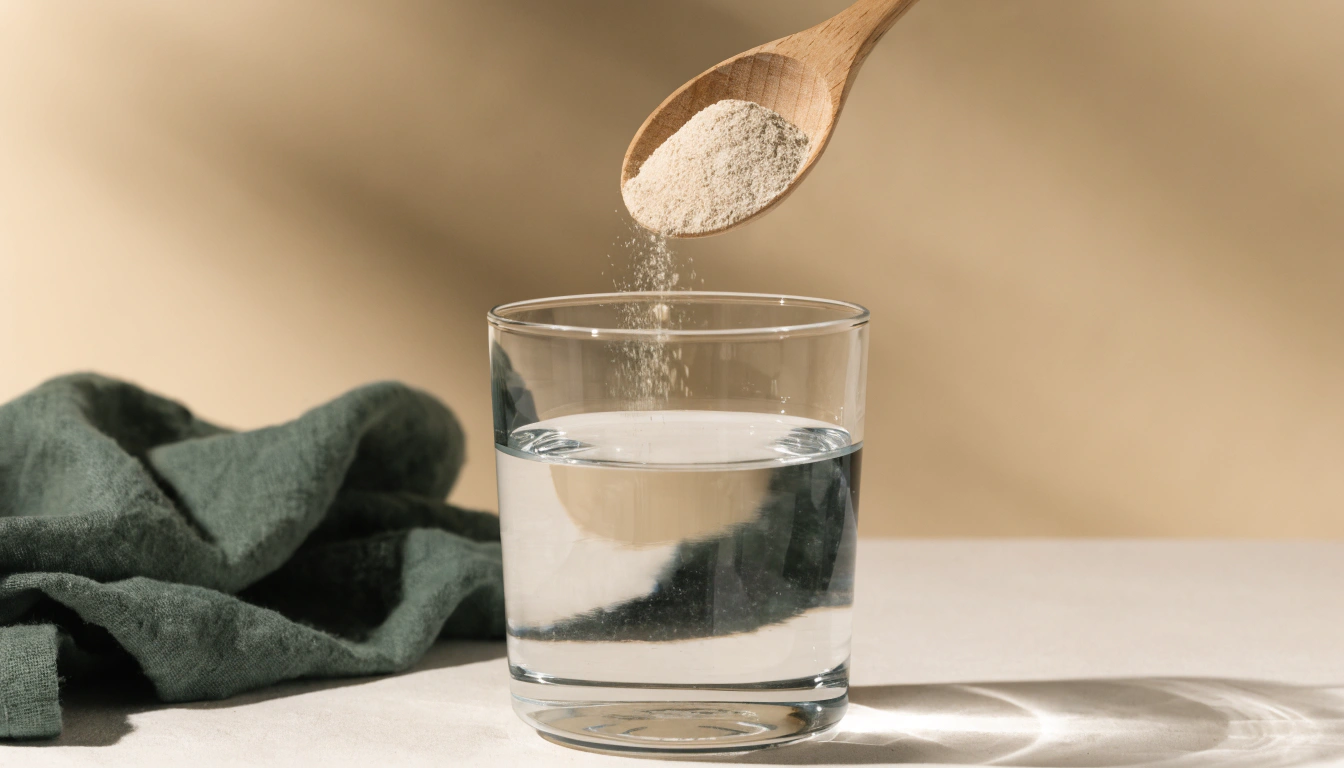
- Mix about 5 grams psyllium in a glass of water (about 2–2.5 dl)
- Stir and drink immediately before it thickens
- Feel free to drink an extra glass of water afterward
If you wait too long, the consistency quickly becomes much thicker than you expected.
If you are new to fiber supplements, it’s wise to start slowly and let your body get used to it.
When you choose psyllium, quality is important. Pure psyllium consists basically only of seed husks from Plantago ovata without unnecessary additives.
Are there any side effects?
Psyllium is a natural fiber source and is well tolerated by most. But since it binds a lot of liquid, it is important to always take it with enough water.
If you start with too large amounts right away, the stomach can react with:
- Gas
- Bloating
- A feeling that the stomach is working harder than usual
It is usually temporary and due to the gut flora adjusting to more fiber.
So what does this mean in practice?
Much of the recent conversation around GLP-1 has been about weight loss. For some people, medication can be an important part of treatment, and that is something that always needs to be decided in consultation with healthcare.
But satiety is really about more than just turning off appetite.
It can also be about something more fundamental: how digestion works and how the body regulates energy, blood sugar, and satiety.
Our bodies already have an advanced system for this.
And sometimes something as simple as a gel-forming fiber like psyllium can make a bigger difference than you first think.
Not as a quick fix. Just a small adjustment in how the body works.
And next time your energy dips a few hours after a meal, it might be worth remembering that your body is often already trying to tell you something.