You might recognize it.
You wake up in the morning and immediately know what day of the cycle it is. That dull ache in your stomach. Maybe in your back too.
You wonder if you should go to work anyway. Or if this will be a day with a heat pad and the couch.
“Periods hurt.”
It’s something many women have heard since their teenage years.
Take a painkiller. Put a heat pad on your stomach. It will pass.
And sure. Mild menstrual pain is common.
But if the pain makes you cancel plans, call in sick to work, or curl up on the couch every month, it’s something else.
Pain that affects your daily life is your body’s way of getting your attention.
Why does menstruation sometimes hurt so much?
When the period starts, the body releases substances called prostaglandins.
They cause the uterus to contract so the lining can be expelled.
It is a completely normal process.
But if prostaglandin levels are high, the contractions can become much stronger.
When the uterus works hard, blood flow to the tissue temporarily decreases, and that’s one reason why the pain can feel so intense.
Prostaglandins are also linked to the body’s inflammatory processes, which means inflammation can also affect how severe menstrual pain becomes.
When is menstrual pain normal?
Many experience menstrual pain already in their teenage years.
That type of pain usually:
- start when the period begins
- be worst on the first day
- subside after a couple of days
Menstrual pain is obviously unpleasant, no matter how mild or severe it is.
But for many, fortunately, it’s a part of the cycle that can be managed with rest, heat, or pain relief.
When the pain doesn’t feel like “normal” menstrual cramps
For some women, the pain is significantly more intense or worsens over the years.
It can start several days before your period, last longer, or make it difficult to function normally during the most painful days.
If menstrual pain affects work, studies, or daily life, it might be wise to talk to a healthcare professional, just to get a better understanding of what’s happening in your body.
In some cases, it may be endometriosis, a condition where tissue similar to the uterine lining grows outside the uterus and can cause inflammation and pain.
At the same time, it’s important to remember that many women have severe period pain without having endometriosis.
Taking the pain seriously is therefore not about trying to diagnose yourself, but about knowing that you don’t have to accept being in pain every month.
What can influence how much period pain you experience?
Period pain is largely affected by two things:
- how much prostaglandins the body produces
- how strongly the uterus contracts
That’s why researchers often look at factors that affect inflammation and muscle function.
Here, certain nutrients become particularly interesting.
Omega-3
Omega-3 fatty acids are involved in how the body produces prostaglandins. The balance between different fatty acids can affect which types of prostaglandins are formed and how strong the signals become.
Magnesium
The uterus is a muscle. Magnesium contributes to normal muscle function and is involved in how muscles relax after a contraction.
Vitamin B6
Vitamin B6 helps regulate hormone activity and participates in several signaling systems active during the menstrual cycle.
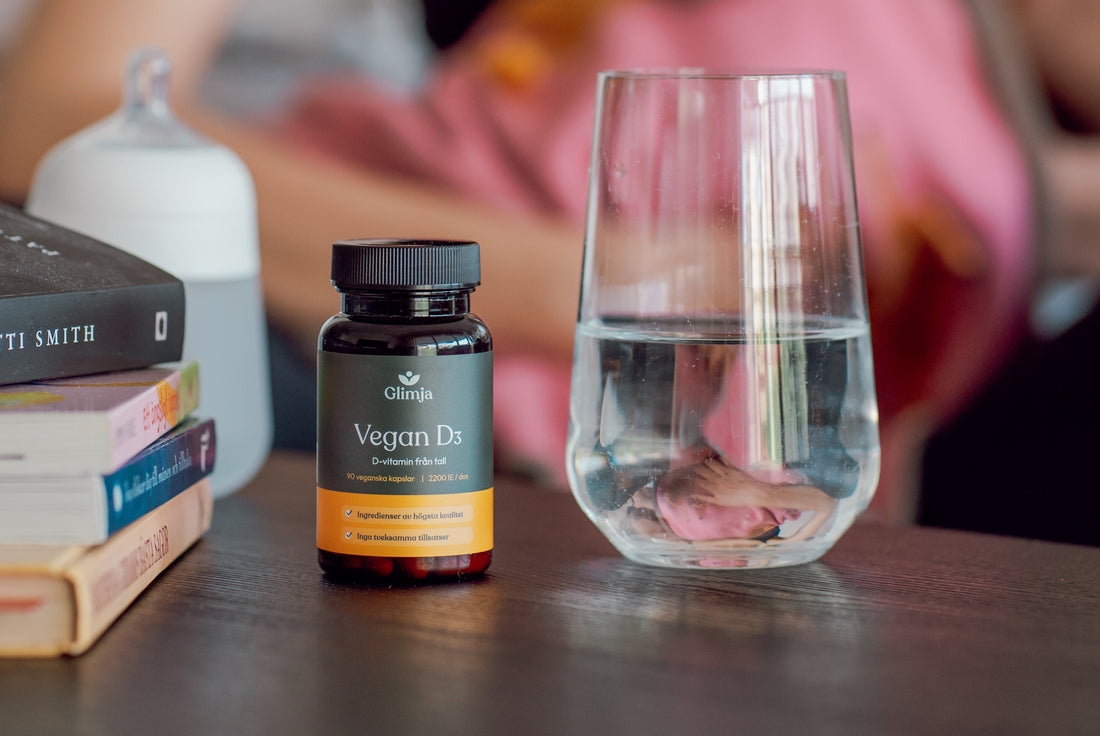
Vitamin D
Vitamin D is linked to the immune system and several processes that affect the body's inflammation levels.
The body uses nutrients in many of the systems active during the menstrual cycle. When levels are low, it can therefore affect how the body handles both hormonal signals and inflammation.
If you choose to take supplements, quality can also matter. Not all products are the same, and how the raw materials are produced can affect how well the body can actually use the nutrients.
Pain is not something you should have to get used to.
Many women go for years thinking that this is just how periods are.
But pain that affects your daily life is not something that should be normalized.
Sometimes there is a medical explanation that needs to be investigated.
Sometimes it involves several factors that together affect the body.
But the first step is often quite simple.
Actually starting to listen to your body.