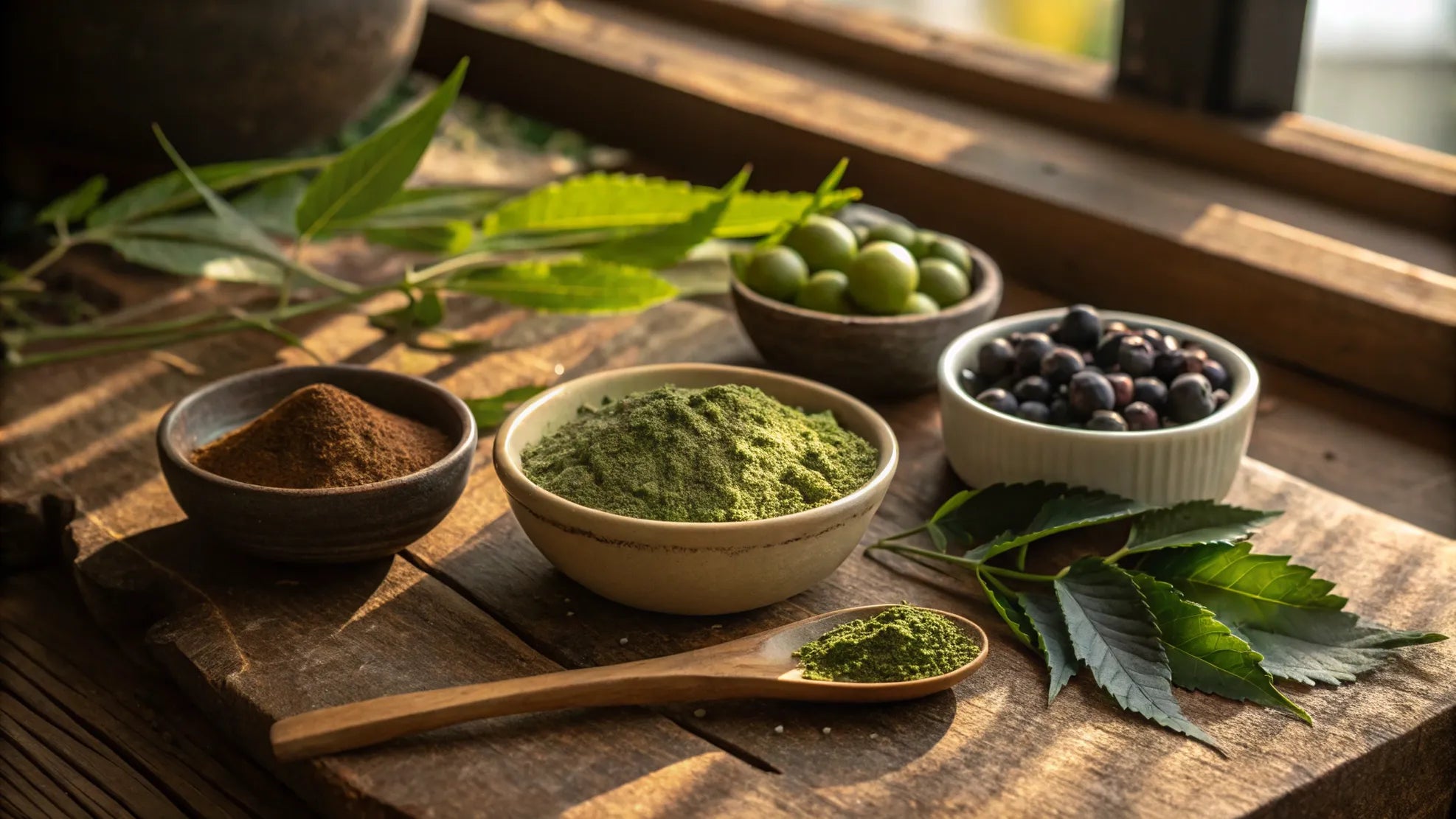
Khadi’s Ayurvedic hair dyes are made in India in a traditional way with recipes from the past.
They work according to Fair Trade and employ locals, and child labor is of course excluded.
The hair dyes are BDIH certified (certified natural cosmetics), 100% herbal-based, vegan-friendly, and chemical-free.
Besides herbal-based hair dyes, Khadi also develops high-quality products for hair and body whose unique properties are based on traditional formulas of handpicked herbs and highly concentrated plant extracts.
Do you have trouble covering white/gray hair?
The problem with herbal hair dyes is that they often do a poor job covering coarse white and gray strands.
On my pure white and thick strands, dark brown shades don’t cover at all, and black is not even recommended for gray hair; it simply doesn’t work.
I can dye the white hairs with pure red shades or mix 10-30% dark brown into a red shade. I have also tried applying a dark brown Logona or Radico on top, but it didn’t take.
Khadi became the solution to the problem. Now we can all dye our grays. Let me take you through this fantastic journey!
Consistency
Khadi has clear instructions on the water temperature when mixing the dye powder. Note that different shades are mixed with different temperatures.
Dark brown should be mixed with 50-degree warm water. They seem to know how it should be done.
Khadi’s hair dyes are permanent and stain both floors and skin. They therefore recommend using a thick cream/oil around the hairline and ears, having newspapers on the floor, and wearing old clothes.
But I could have skipped all the newspapers, as the dye neither crumbled nor splattered. Still, I guess I should protect the floor just in case I mess up when I least expect it.
Khadi’s hair dye is very creamy and feels almost like a cream hair dye.
Economy
The dye I tested is Khadi Dark Brown and it is not nearly as economical as Radico’s hair dye. One package is enough for shoulder-length hair.
If you have thick and a lot of hair, it’s safest to get an extra package, so buy two.
How to get good results on white/gray hair with herbal hair dye
Khadi recommends a 2-step dyeing process for gray to medium blonde/medium brown hair if you want the shades dark brown, black, or indigo as the final result.
For an intense and covering result, you should first dye bright red with either Henna, Amla, or Jatropha, then dye with a darker color on top.
1. Dye the roots
A little less than half a package of hair dye is needed for the roots.
I had Sante Naturröd at home, so I dyed the roots with it and let it sit for 1.5 hours.
2. Dye the entire hair
Since it got so late, I continued coloring the next evening with Khadi Dark Brown. I let it work for 2 hours and used only the included cap (no towel on top).
One thing I noticed was that it was very soothing for the scalp. The other hair colors are also lovely and calming, but Khadi’s felt extra nice. Maybe it’s the neem herb that does it.
Khadi’s creamy hair color is easy to rinse out, which is appreciated when coloring late in the evening.
Khadi recommends not washing with shampoo immediately after coloring, but at the earliest after 24 hours. I rinsed only with water, no conditioner. I had mixed a little too little color, so it was sparse in some places, but look at the result!
3. Check out the result
It worked!
Next time I have to color with the red shades Khadi recommends in the 2-step coloring and black. As a bonus, I got strength and shine in my hair!
1. Hair before coloring (dry hair)
My hair before coloring. White roots and some old reddish-brown color left.
2. Result after the first step
After 1.5 hours with Sante natural red. In bathroom light it looks almost brown, but in reality and especially in daylight the hair is very red.
3. Result after the second step (wet hair)
After 2 hours with Khadi Dark Brown, wet hair.
4. Final result (dry hair)
After 2 hours with Khadi Dark Brown, dry hair. The fine “baby hairs” at the front turned really dark brown and the coarse white strands turned brown. The red is not visible.
Rating of Khadi’s herbal hair color
Pros:
+ fully covers white hair in a 2-step coloring with red as the base.
+ is creamy and doesn’t crumble.
+ extra soothing on the scalp.
+ easiest to rinse out compared to the other herbal hair colors.
+ gives extra fresh and shiny hair.
Cons:
– of all the herbal hair colors in the shop, Khadi feels the least concentrated.
Tip:
Some see it as a downside that Khadi doesn’t have many shades to choose from, but I don’t see it as a problem since you can easily mix a unique color with the base shades available.
So mix away!
Is there a big difference between Khadi’s and Radico’s herbal hair colors?
Khadi’s hair colors consist of herbs, just like Radico’s hair colors. They are similar in ingredients but not identical. Here you can see an example of the difference in ingredients (INCI) between two dark brown shades:
Khadi Dark Brown: Indigofera Tinctoria (Indigo) – Lawsonia Inermis (Henna) – Emblica Officinalis (Amla) – Eclipta Alba (Bhringraj) – Azadirachta Indica (Neem).
Radico Dark Brown: Lawsonia Inermis (Henna), Emblica Officinalis (Amla), Eclipta Alba (Bhringraj), Indigofera Tinctoria (Indigo), Trigonella Foenum-graecum (Methi), Hibiscus Rosa Sinensis (Hibiscus), Coffea Arabica (Coffee), Rubia Cordifolia (Manjistha).