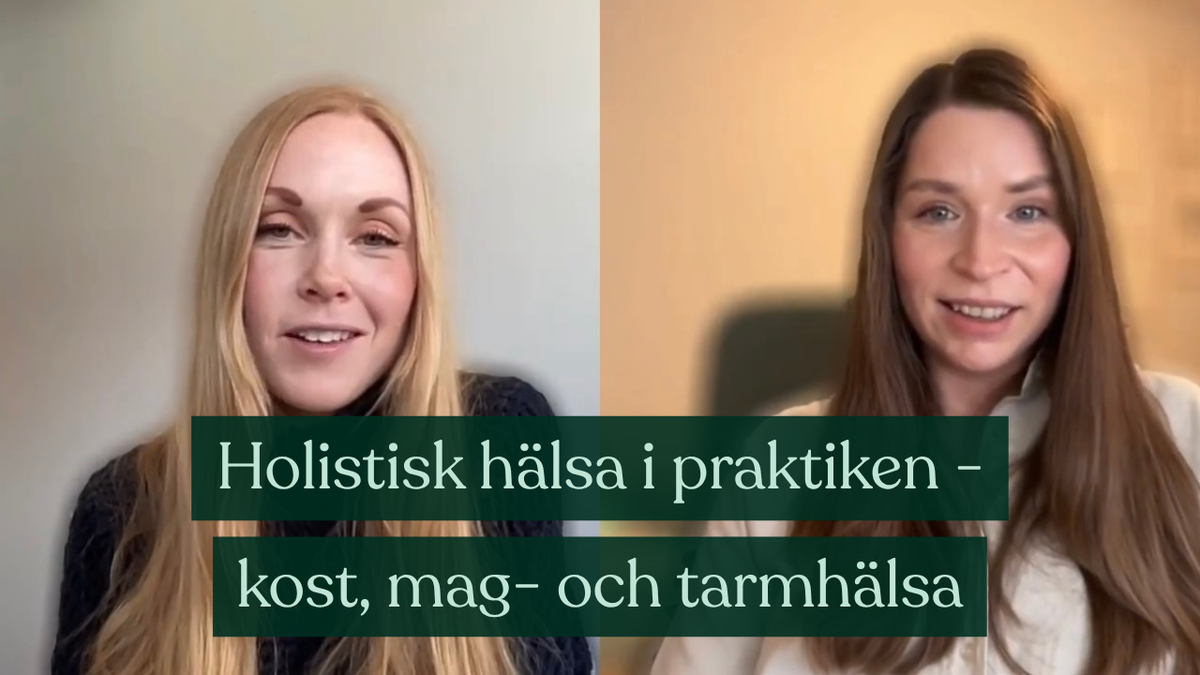
In the first episode of Hälsodjungeln, Glimja’s health expert Emma Köhn meets health coach and public health scientist Frida Nyman for a conversation about holistic health, gut health, and an anti-inflammatory lifestyle. They discuss everything from diet, sleep, and stress to why small, sustainable changes are often more valuable than extreme diets and health trends.
Watch, listen, or read—choose what suits you
🎧 Listen to the episode on Spotify
🎧 Listen to the episode on Apple Podcasts
Episode transcript
Emma Köhn, Glimja health expert (00:00)
You’re now one of our health experts.
Frida Nyman, Health Coach, Nutrition Advisor & Public Health Scientist (00:04)
Yes, that’s great fun.
Emma Köhn, Glimja health expert (00:07)
We’re really excited to have you join the team and to benefit from your knowledge. We’ll cover all sorts of topics in this episode, but I thought you could start by telling us a little about yourself and your background.
Frida Nyman, Health Coach, Nutrition Advisor & Public Health Scientist (00:28)
Absolutely. I’m a public health scientist by training and have worked with public health issues for several years. I’m also a health coach, nutrition advisor, and trained stress educator. I’m truly passionate about health, and have been for a long time.
Over the past few years, I’ve run my own business, helping individuals improve their health in various ways. I’m very interested in plant-based nutrition, gut health, stress, and the nervous system, as well as how all these things affect us. I also find it fascinating how fairly simple tools can strengthen your health enormously. Many of these things are free, too—small changes can make a big difference.
So I suppose you could call me a health nerd.
Emma Köhn, Glimja health expert (01:30)
Like everyone at Glimja. That’s really the common thread here. Today, we’re going to take a proper deep dive into how everything is connected.
Since this is the first episode, I’d also like to briefly introduce myself for those of you who don’t know me. Some of you may recognize my name from the newsletters or Glimja’s blog articles. That’s where I’ve appeared before, and now here as well. I’m really looking forward to hosting conversations with all the health experts we have at Glimja, and I’m glad you’re the first guest.
Let’s start from the beginning: you’re a hairdresser by training. How did you get into health?
Frida Nyman, Health Coach, Nutrition Advisor & Public Health Scientist (02:24)
In high school, I thought I wanted to become a hairdresser, but I quickly realized that it wasn’t the right path for me. I’ve always been interested in health, but that interest grew stronger as I got older. That’s when I found a university program called the Public Health Program.
I studied public health at university for five years, and that’s where my interest in health really took off. The fact that I could also work with health and make a living from it felt fantastic. Since then, I’ve continued learning more and more.
I’ve also been on my own health journey. So I’ve learned both through my studies and through my own experiences. I had severe stomach problems, body aches, and joint problems myself, and a holistic perspective on health helped me enormously.
Emma Köhn, Glimja health expert (03:41)
When did those problems start? None of us is particularly old, so it sounds early to have problems like that.
Frida Nyman, Health Coach, Nutrition Advisor & Public Health Scientist (03:49)
My stomach problems started very early. They weren’t very serious at first, but they got worse over the years. Eventually, it felt like I completely crashed. Often, you reach a point where you feel you really have to do something.
You may not get the help you need from healthcare, or you may not find out what’s wrong. Then you start looking for ways to feel better yourself. That’s how I discovered holistic health, natural tools, and trying to understand the root cause of why you feel the way you do. What is behind the symptoms, and what can you do yourself to feel better?
Emma Köhn, Glimja health expert (04:44)
Let’s go back a little: public health science is a fairly broad concept. Many people may think of the pandemic when they hear “public health.” What does the program actually involve?
Frida Nyman, Health Coach, Nutrition Advisor & Public Health Scientist (05:03)
Public health is a very broad subject, and you can work in many different areas. One area is lifestyle habits, which I have worked extensively with myself. For example, you can work with dietary habits, mental health, and the work environment.
There are also areas such as infection control, which many people became more familiar with during the pandemic. Essentially, you learn how to promote health at different levels of society—the individual, group, and societal levels—and look at what authorities, municipalities, and other stakeholders can do.
You also learn about the determinants of health: which factors strengthen our health and which affect it negatively. It’s a very broad and interesting field.
Emma Köhn, Glimja health expert (06:11)
I can imagine that it’s very rewarding to build on that with additional training, as you have done.
You also work with clients one-to-one. What kinds of problems do people come to you with?
Frida Nyman, Health Coach, Nutrition Advisor & Public Health Scientist (06:38)
I’m quite focused on gut and digestive health, but also on other chronic and long-term symptoms where people may feel they aren’t receiving the right help from conventional healthcare.
At the same time, I always want to emphasize that Sweden has fantastic emergency care and care for seriously ill patients. It’s incredibly important. But I believe we need to get better at combining it with a more holistic perspective.
Doctors often have limited time and may not have time to ask about stress, eating habits, sleep, relationships, and other aspects of life. That’s where people may feel they aren’t getting all the support they need.
Many people who come to me have, for example, IBS or other digestive issues that greatly limit their lives. Others have pain, bloating, or other vague symptoms. When healthcare providers can’t find a clear explanation, there may be a need for more support and guidance regarding lifestyle and the bigger picture.
Emma Köhn, Glimja health expert (08:28)
Then I’d like to pause at the concept of holistic health, since it’s used quite a lot. What does holistic health mean to you?
Frida Nyman, Health Coach, Nutrition Advisor & Public Health Scientist (08:50)
For me, holistic health is about looking at the whole picture. Many different things affect our health, and we need to have the basics in place to feel well.
We need to sleep properly and get good-quality sleep. We need to eat food that provides nourishment and energy and supports gut health. We need healthy relationships and a sense of purpose in life. Stress also affects our entire system.
You don’t have to be perfect in every area, but often you need to work on several aspects at the same time. It may not be enough to focus exclusively on one thing. For one person, diet may be the most important factor, while someone else may also need to work on their relationships, change jobs, do more of what they enjoy, or stop pushing themselves to the limit.
Emma Köhn, Glimja health expert (10:23)
It’s difficult in the society we live in today, which is often designed to make us push ourselves.
If you have vague symptoms, such as chronic fatigue or headaches, you don’t necessarily look at supplements first. You look at the individual as a whole.
Frida Nyman, Health Coach, Nutrition Advisor & Public Health Scientist (10:52)
Exactly. The foundation needs to be in place. You can start by reviewing your situation: what is it that I need to improve, and what can I begin to adjust?
Supplements can certainly be important if you have nutritional deficiencies or something similar, but the basics need to be in place. A supplement will rarely be the only thing you need if you’re also eating a lot of highly processed food or not prioritizing your sleep.
It’s about looking at the root causes. Diet is an incredibly important part and, I would say, one of the most important foundations.
Emma Köhn, Glimja health expert (11:58)
If we were to name four or five cornerstones, what would they be?
Frida Nyman, Health Coach, Nutrition Advisor & Public Health Scientist (12:08)
Sleep, good food and nutrition, movement, emotional health, and mental health.
Emma Köhn, Glimja health expert (12:24)
I think emotional health is the part that many people forget. It is easier to focus on diet because it is something concrete that you can physically engage with, whereas the other parts can feel more abstract and difficult.
Frida Nyman, Health Coach, Nutrition Advisor & Public Health Scientist (12:48)
Yes, and it can also be about the mental aspect: What thoughts are you feeding yourself throughout the day? What beliefs do you hold about yourself, others, and the world? Our thoughts affect our feelings and actions.
In my own journey, reviewing my thought patterns has been an important part. Thoughts and feelings also create reactions in the body.
Emma Köhn, Glimja health expert (13:29)
Do you have any specific tools for that? Journaling, for example, is very popular right now.
Frida Nyman, Health Coach, Nutrition Advisor & Public Health Scientist (13:43)
Absolutely. People like different things, but writing down your thoughts and feelings and reminding yourself what you are grateful for can be very beneficial.
I personally really enjoy meditation and visualization. I also use body-based tools that involve working with the senses and bodily awareness to calm the nervous system.
I have a broad toolbox and believe you should try different things to find what works for you. Just because I love visualization meditations does not mean they are right for someone else. However, there are some basic things that apply to all of us: we need to sleep and eat well. No one feels good living on highly processed food and soda seven days a week.
Emma Köhn, Glimja health expert (15:05)
You advocate an anti-inflammatory lifestyle, where the diet is largely plant-based. I think food can feel overwhelming for many people, especially if they are used to processed foods. Many people think they have to make enormous changes from one day to the next. Where do you start?
Frida Nyman, Health Coach, Nutrition Advisor & Public Health Scientist (15:46)
I see many people in the health field recommending diets and regimens that are very difficult to maintain over time and may not even be what people need.
What we need is a large proportion of food from the plant kingdom. This helps strengthen the gut flora, which in turn has a major impact on the rest of the body, including the immune system, mental health, and skin health.
Many people are also afraid of carbohydrates; previously, many were afraid of fat, and now we have a strong focus on protein. I think we need to return to the bigger picture and eat a wide variety of foods from the plant kingdom.
Emma Köhn, Glimja health expert (17:05)
And that applies even if you don't want to give up meat. Variety from the plant kingdom is still important.
Frida Nyman, Health Coach, Nutrition Advisor & Public Health Scientist (17:21)
Absolutely. Regardless of what type of diet you follow, it's beneficial to include more foods from the plant kingdom.
Everyone starts at a different level. You have to start somewhere, and it doesn't have to be with wheatgrass juice every morning. For some people, going all in works, but for most, I believe in taking one step at a time.
The first step could be to buy some vegetables you like and serve them with lunch or dinner, start having a smoothie once a week, take more walks, get out in the daylight, drink more water, or go to bed earlier. Small steps in the right direction can make a big difference.
Emma Köhn, Glimja health expert (18:43)
What does your own daily life and routine look like?
Frida Nyman, Health Coach, Nutrition Advisor & Public Health Scientist (18:48)
I'm very much a morning person, although of course not everyone is. The morning is my time of day. I often get up at five and usually eat breakfast fairly soon afterward because I'm very hungry in the morning.
There's an idea that you have to fast for many hours to be healthy, but that doesn't suit everyone.
After breakfast, I always move in some way, either by taking walks or exercising. I've learned to listen closely to my body and check in with what I need that particular day.
I also usually do some form of mindfulness, meditation, or visualization meditation. Then my day begins.
Emma Köhn, Glimja health expert (20:10)
That sounds wonderful, but if you work a nine-to-five job, have to get to the office quickly and perhaps drop your children off at preschool—what would you advise someone like that to prioritize? You don't always have time to fit in every aspect.
Frida Nyman, Health Coach, Nutrition Advisor & Public Health Scientist (20:34)
It depends a lot on the individual's situation, but I often start with what you put on your plate. Your diet can really change your energy levels, and you have to arrange food every day anyway.
If you're not used to cooking from scratch, it can feel time-consuming, but a lot of it comes down to habits. If you're going to cook anyway, healthy food doesn't have to take much longer. In fact, it can often be easier.
Emma Köhn, Glimja health expert (21:36)
The ingredients are often simpler too. For many years, we've had a routine of doing meal prep on Sundays. That makes the rest of the week much easier, and you don't have to think about what to eat every day.
Food should of course be tasty, but it doesn't have to be a sensation every time you eat. For example, we can have root vegetables prepared in the fridge and then vary the side dishes—perhaps a salad with mango and avocado one day. The sauces and dressings don't have to be complicated.
Frida Nyman, Health Coach, Nutrition Advisor & Public Health Scientist (22:29)
Food prep is great, as is keeping meal portions in the freezer if you need them. I also think it’s important to stock up on healthy food. When you open the fridge, you want to be inspired by the vegetables and ingredients you see there.
What we have at home is usually what we reach for when we’re hungry, especially when we come home tired after work.
If you’re used to highly processed food with lots of sugar, salt, and strong flavors, there may also be an adjustment period. Your taste preferences can change, and you may begin to appreciate simpler, more natural food in a completely different way.
Emma Köhn, Glimja health expert (23:30)
It’s incredibly exciting, because it really is possible to change your taste preferences.
Frida Nyman, Health Coach, Nutrition Advisor & Public Health Scientist (23:33)
Yes, it is. In the beginning, it can feel difficult because you’re not used to it. I grew up eating a lot of sweets and sugar myself, and when I was younger, I didn’t think nearly as much about what I ate.
I’ve made a huge change and know that it’s possible to move away from strong sugar cravings and truly begin to appreciate healthy food.
Emma Köhn, Glimja health expert (24:12)
I notice it myself. Regular milk chocolate can taste incredibly sweet today, even though I used to love it. Now I’d rather choose very dark chocolate.
It’s exciting that food can feel like such a huge change at first, but when you take it step by step and start noticing that you feel better, your preferences change too.
When you learn more about what food does to the body, you can regain a sense of empowerment. You can influence a great deal yourself. Medication may absolutely be necessary, but you’re not entirely helpless—there are often things you can do yourself for your health as well.
Frida Nyman, Health Coach, Nutrition Advisor & Public Health Scientist (25:36)
Yes, diet and other natural tools can make a big difference. Many people are surprised by how much better they can feel when they start strengthening their gut health and changing their habits.
Emma Köhn, Glimja health expert (26:17)
I also think it’s interesting how people sometimes ask: if you don’t eat all those products from the store with loads of ingredients, what do you eat then? It says something about how far we’ve moved away from our sense of what real food actually is.
Frida Nyman, Health Coach, Nutrition Advisor & Public Health Scientist (26:56)
Many people may see someone who eats very naturally as extremely healthy, when in reality they are simply eating fairly simple food. Our grocery stores are filled with highly processed products.
Emma Köhn, Glimja health expert (27:23)
When it comes to processed food, what is it that makes it so difficult to stop eating, and what does it do to the body?
Frida Nyman, Health Coach, Nutrition Advisor & Public Health Scientist (27:42)
Highly processed food is very heavily processed and often designed in a way that makes us want to keep eating it. Combinations of flavor, texture, sugar, salt, and fat can make it highly rewarding.
At the same time, the body gets less of what is found in whole foods—for example, fiber and various nutrients. If a large part of the diet consists of highly processed food, it can negatively affect blood sugar, satiety, and gut health, among other things.
Emma Köhn, Glimja health expert (28:53)
You work a lot with gut health, and we know that the gut and brain are interconnected. How can food affect our mental well-being?
Frida Nyman, Health Coach, Nutrition Advisor & Public Health Scientist (29:18)
The gut and brain are truly interconnected, partly through the vagus nerve and several different signaling pathways. Gut health is not only connected to digestive problems but also to many other aspects of how we feel, such as energy and mental well-being.
Emma Köhn, Glimja health expert (29:54)
And we live in a time when mental well-being really is not at its best, so it feels important to keep that in mind.
We touched on how you can be questioned when you choose a different path from the norm. Everything has to happen quickly; you are supposed to fit in a thousand activities, and perhaps you no longer prioritize spending time in the kitchen. If you feel that something is not right but choose to do things differently, it can be scary.
Frida Nyman, Health Coach, Nutrition Advisor & Public Health Scientist (30:51)
Yes. Choosing your own path instead of doing what everyone else does can lead to people questioning you. But I believe we need to create awareness and start checking in with ourselves: what is right for me?
You do not have to do what everyone else does. Pay attention to what feels right, listen to your intuition, and dare to follow your own path. You often find other people who think the same way, too.
And you can inspire others. In my own family, several people have become curious and wanted to try new things. Sometimes we also have preconceptions about how others will react, even though they may not think as negatively as we believe.
Emma Köhn, Glimja health expert (32:06)
It often says something about our own thoughts. I have seen the same thing in my family, where, for example, my mother has started living differently and gotten rid of several symptoms.
You have also largely chosen to abstain from alcohol. For our generation, millennials, that can be quite a significant social statement. What has it been like for you?
Frida Nyman, Health Coach, Nutrition Advisor & Public Health Scientist (33:01)
In general, alcohol consumption has decreased among younger people, which is positive. But when I was growing up and younger, I was definitely questioned because I never really felt that alcohol was for me.
Today, I think people are often more accepting, even though there is still curiosity about why you choose not to drink. I know many people can feel pressured to drink at dinners and events because it’s what’s expected of them. You don’t want to be difficult or be questioned.
I think you can ask the same question here as in other areas: Is this really something I want? The same applies to how hard you push yourself at work or what food you eat. Start questioning the norm and check in with what you want to give your body.
Emma Köhn, Glimja health expert (34:41)
I can really relate to that. For me, changing my relationship with alcohol almost became an identity crisis. These days, I essentially avoid it completely, with perhaps the occasional exception at a special event.
I was diagnosed with epilepsy when I was 18, an age when you may not be particularly receptive to being told that you should be careful with alcohol. For many years, my identity was strongly tied to being the fun girl who went out every weekend. Then questions arise: Who am I if I stop? Will I still have the same friends? Will the invitations keep coming?
But once you come out the other side and notice how much better you feel, the choice becomes easier. And I think the same way about food: it doesn’t have to be all or nothing. You can live 80 or 90 percent of the time in a way that makes you feel good and make exceptions when you genuinely want to, not because you feel forced to.
Frida Nyman, Health Coach, Nutrition Advisor & Public Health Scientist (36:56)
Exactly. You need to let go of the stress of trying to be perfect. There is no perfect way to live.
Often, once you’ve made the change, you find yourself choosing the healthy option more and more because you know how you’ll feel otherwise. For me, it has been a gradual journey. You start somewhere and then add more things as you get to know yourself and notice what makes you feel good.
I don’t live perfectly now either, and that isn’t the goal. The important thing is to identify the big things that make a difference for you and choose them as often as possible, without creating additional stress.
Emma Köhn, Glimja health expert (38:07)
I think many people feel a great deal of pressure these days from all the health advice on social media. One expert after another says that you have to follow their particular diet or method. On top of that, there are all the gadgets—watches and rings that tell you how you’re doing—instead of actually checking in with yourself.
I’m sitting here with an Oura Ring myself, so technology can definitely be interesting. But it mustn’t replace the basics.
Frida Nyman, Health Coach, Nutrition Advisor & Public Health Scientist (38:45)
Technology can be interesting, but you still have to consider the bigger picture. Many people think they have to do something extreme, such as follow a strict diet, in order to feel well or heal.
Emma Köhn, Glimja health expert (39:20)
And often the goal becomes very concrete, such as losing weight or getting fit for the summer, instead of actually feeling good in the long term.
When I say that I eat an anti-inflammatory diet because it makes me feel good, people can almost find that a stranger answer than if I had said I want to lose weight. We seem to find concrete goals easier to understand than the feeling of long-term well-being.
Frida Nyman, Health Coach, Nutrition Advisor & Public Health Scientist (40:11)
Yes, and then people often go all in with both exercise and diet in a way that isn’t sustainable in the long term. You might start counting calories. I don’t, and I also don’t recommend that it needs to be your starting point.
Another common mistake is being afraid of entire food groups, such as carbohydrates. Of course, carbohydrates vary in quality, but if you eliminate them indiscriminately, you may also consume less of the fiber that gut bacteria need.
It’s easy to fixate on a single food or macronutrient instead of considering the bigger picture.
Emma Köhn, Glimja health expert (41:19)
I was personally terrified of carbohydrates for a while. Health trends have a major influence on people. In the 1990s and early 2000s, many people were instead afraid of fat.
The same applies to fasting—it may suit some people, but you need to be careful about assuming that one method works for everyone.
Frida Nyman, Health Coach, Nutrition Advisor & Public Health Scientist (42:05)
Yes, we are all very different. A natural overnight fast can be beneficial, but longer fasts aren’t suitable for everyone and can be very stressful for the body.
At the beginning of my own journey, prolonged fasting was very popular, and I was desperate to try different approaches. I tried it, but felt incredibly unwell and lost all my energy. It was a clear example of how a method that works for someone else isn’t necessarily right for me.
Emma Köhn, Glimja health expert (42:59)
And then it’s easy to start questioning yourself: is there something wrong with me because I can’t manage this, when it seems to help others?
Frida Nyman, Health Coach, Nutrition Advisor & Public Health Scientist (43:12)
Exactly. You also don’t always know how open other people are about everything they do or how they actually feel. One thing may help one person, while someone else needs something completely different.
Emma Köhn, Glimja health expert (43:34)
We have talked about the cornerstones of holistic health and a lot about food, but not in as much depth about what an anti-inflammatory lifestyle involves. Can you elaborate?
Frida Nyman, Health Coach, Nutrition Advisor & Public Health Scientist (43:58)
An anti-inflammatory lifestyle can be very broad and ties in with holistic health. If we focus on diet, it’s about eating food that supports the body, but you can also consider things such as skincare, environmental factors, and the utensils you use in the kitchen.
It’s not about becoming perfect, but about reducing unnecessary exposure where you can while also prioritizing the big things: sleep, food, movement, and recovery.
Emma Köhn, Glimja health expert (44:50)
It’s probably important to say that you can’t make every aspect perfect. Not everything is available as organic, and cost is also a factor. You have to make the best choices you can based on your own circumstances.
Frida Nyman, Health Coach, Nutrition Advisor & Public Health Specialist (45:28)
Exactly. Many people also think that eating healthily has to be very expensive, but it depends a lot on what you choose. You don’t have to be perfect.
You can’t influence certain environmental factors, but there are often small adjustments you can make to reduce exposure to things you don’t want to be exposed to. That doesn’t mean you need to move out into the woods or never eat at a restaurant again.
When it comes to food, there are also many foods, herbs, and spices that may be interesting to include in a varied diet.
Emma Köhn, Glimja health expert (46:34)
Can you give a few examples?
Frida Nyman, Health Coach, Nutrition Advisor & Public Health Specialist (46:36)
Herbs and spices are very interesting. Turmeric is a classic example, as is ginger. Cloves are also widely used and are interesting from several perspectives.
Emma Köhn, Glimja health expert (46:58)
I’d like to add a little side tip. A follower on Instagram suggested using turmeric together with coconut oil when brushing your teeth. I actually think it gives a refreshing feeling, although of course it’s not the same as professional teeth whitening.
Frida Nyman, Health Coach, Nutrition Advisor & Public Health Specialist (47:46)
It’s fun how much you can make yourself. For example, I make my own deodorant, and you can also make your own skincare products. These days, there’s an incredible amount of inspiration and recipes to find.
Emma Köhn, Glimja health expert (48:02)
How do you make your deodorant?
Frida Nyman, Health Coach, Nutrition Advisor & Public Health Specialist (48:06)
I usually use coconut oil, baking soda, and potato starch. If you like, you can also add an organic essential oil, such as lavender, but you can make it completely fragrance-free if you have sensitive skin.
It’s a very simple mixture, and you have to try things out to see what your skin tolerates.
Emma Köhn, Glimja health expert (48:48)
I’m not quite at the point of making my own deodorant yet, but I use natural deodorant. You also have to try things out because they don’t all work equally well.
These days, though, I make my own cleaning products. It's much cheaper when you have the basic ingredients at home, and it feels good to keep the home as simple as possible when it comes to products.
Frida Nyman, Health Coach, Nutrition Advisor & Public Health Specialist (49:32)
How do you do that, then?
Emma Köhn, Glimja health expert (49:36)
I have an all-purpose cleaner with baking soda, citric acid, water, and sometimes tea tree oil or lavender oil. I keep a ready-filled spray bottle in the cupboard and refill it when needed.
It's a bit of fun to experiment and see what works. But it's also a process—you don't have to start with everything at once.
Frida Nyman, Health Coach, Nutrition Advisor & Public Health Specialist (50:24)
Exactly. You might not start there, but as you become more interested, there's so much to explore.
Emma Köhn, Glimja health expert (50:33)
We could have talked for hours, but as we begin to wrap up: if someone listening has been inspired to start eating better or embrace a more holistic lifestyle, what would your advice be? What is the first step?
Frida Nyman, Health Coach, Nutrition Advisor & Public Health Specialist (51:03)
The first step is to become aware of your own situation and then make changes based on it. It may be a tiny step, but that step leads onward along a new path.
Find your why and decide to make a change. You need to be willing to do the work, even if you take it one step at a time.
Emma Köhn, Glimja health expert (51:38)
It can probably help to sit down and actually write it down instead of just keeping everything in your head. Then you can consider which path you want to take and which small steps are realistic.
Frida Nyman, Health Coach, Nutrition Advisor & Public Health Specialist (51:51)
Yes. Get help, read, and gather knowledge, but don't get stuck just reading. Eventually, you also need to start taking action. Begin with the basics and take a first step toward improving your health—without making it so complicated that it creates stress in itself.
Emma Köhn, Glimja health expert (52:21)
It's been so much fun talking to you, Frida. Thank you so much. Please come back again so we can explore individual topics in greater depth.
Frida Nyman, Health Coach, Nutrition Advisor & Public Health Specialist (52:34)
I'd be happy to.
Emma Köhn, Glimja health expert (52:37)
If you'd like to get in touch with her, you can find her on our website under health experts. You can also go directly to her website, fridanyman.se, and find her on social media.
Thank you so much for today.
Frida Nyman, Health Coach, Nutrition Advisor & Public Health Specialist (53:20)
Thank you, likewise. It's great to be here.
Emma Köhn, Glimja health expert (53:23)
Absolutely. We'll schedule another conversation.
More episodes of Health in Depth
Discover more conversations with experts who share knowledge, perspectives, and practical advice on health, nutrition, and well-being.