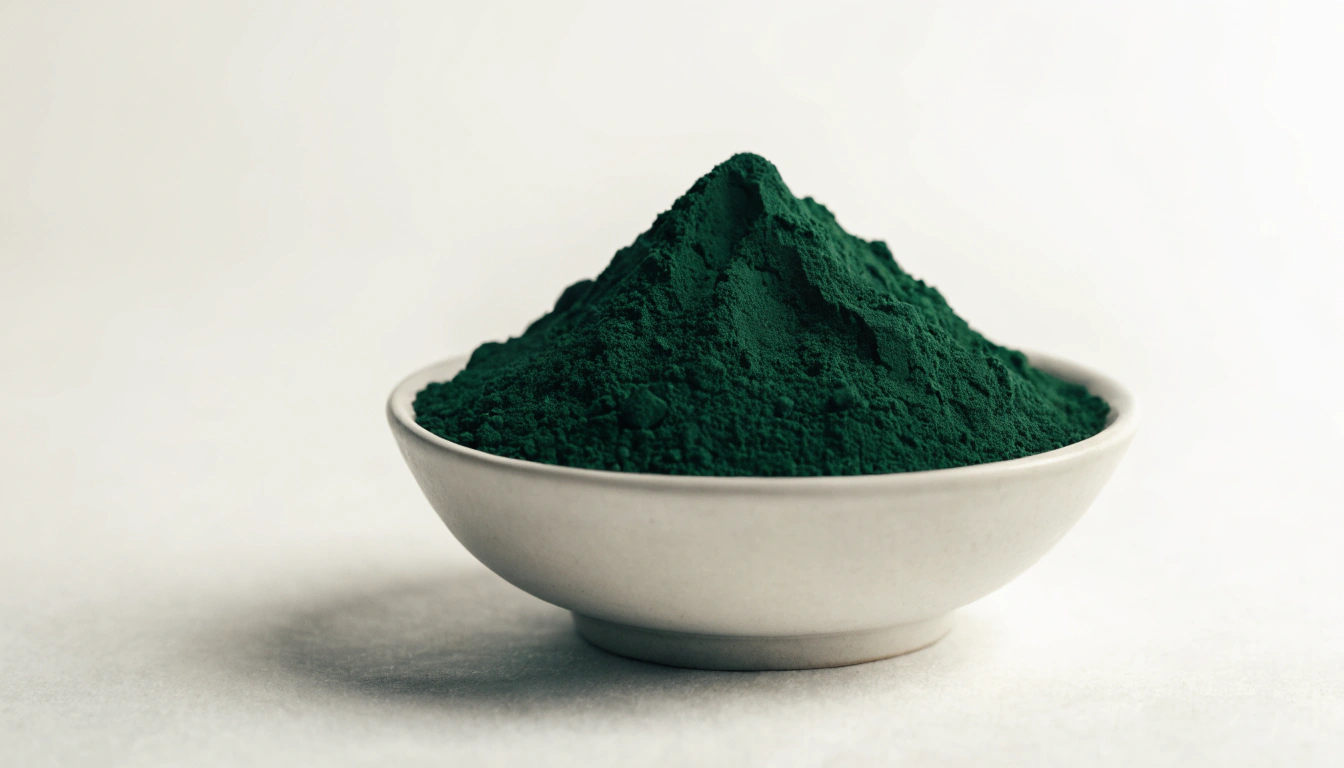
Maybe you’ve already discovered spirulina? I at least don’t think you’ve missed it. It’s been everywhere for quite a while now. In smoothies, capsules, and green powders. That blue-green color is hard to miss.
But it’s really not the color that makes spirulina so interesting, no matter how nice it makes your breakfast look.
It’s the content.
Spirulina has been used for thousands of years and is packed with protein, vitamins, and antioxidants. That’s also why it’s often highlighted as a true superfood.
But what does it actually do in the body?
And can it affect women and men differently?
What is spirulina? Nutrition, content, and why it’s considered a superfood
Spirulina is a concentrated powder made from dried algae that grow in both fresh and saltwater.
Technically, it is a cyanobacterium, an organism that can convert sunlight into energy through photosynthesis. This is also what makes the nutrient content so concentrated.
To make it more concrete, a single tablespoon contains approximately:
- 4 grams of protein
- 2 milligrams of iron
- 13 milligrams of magnesium
- 95 milligrams of potassium
- 6.5 micrograms of folate
- 4.6 milligrams of choline
In addition, you get all essential amino acids, along with substances like beta-carotene, vitamin A, copper, selenium, and antioxidants.
What makes spirulina especially interesting is that the body seems to absorb the nutrients effectively. This means it not only looks good on paper but is actually used by the body.
Phycocyanin – the compound in spirulina that research focuses on
Most of the interest around spirulina centers on a substance called phycocyanin.
This is what gives spirulina its blue-green color. But it’s not just a pigment. Phycocyanin has been linked in studies to how the body manages oxidative stress and inflammation.
This is also what research repeatedly returns to.
Laboratory studies have also shown that it can affect various types of microorganisms. For example, it has been shown to inhibit the growth of certain bacteria, including antibiotic-resistant strains and bacteria linked to acne.
There are also observations of antifungal activity, meaning that in some studies it has been able to counteract the growth of certain types of fungi.
Researchers have also looked at spirulina in relation to heavy metals like lead, mercury, cadmium, and chromium. This concerns how spirulina's antioxidant content may play a role in how the body handles this type of burden.
It is still early research, but it says something about how broadly spirulina is actually being studied.
Spirulina and immune system, blood sugar, and heart health
Spirulina contains several bioactive compounds linked to the immune system, that is, how the body handles what it is exposed to.
There are also studies that have looked at spirulina in relation to blood pressure, cardiovascular health, and blood sugar.
When it comes to blood sugar, the picture is not entirely clear.
In some studies, changes in fasting blood sugar have been seen, while others have not observed any clear effect on long-term values or after meals. There are also studies on healthy individuals where the results vary.
So the results are somewhat mixed. But they are still interesting.
The same applies to cardiovascular health. Spirulina has been linked to things like cholesterol, blood pressure, blood sugar, and weight, and one explanation being studied is its antioxidant properties and how blood vessels are affected.
There is also early research looking at tumor cell growth, but we are still far from any clear conclusions there.
Spirulina and energy – why many experience steadier levels
Many start with spirulina specifically for the energy.
But it is usually not about a quick effect, rather how the energy feels over time. When the body receives nutrients that are absorbed efficiently, many experience a steadier level, rather than peaks and valleys.
Spirulina is rich in plant-based protein, and since protein breaks down more slowly than fast carbohydrates, the energy is released more gradually.
Research has also looked at spirulina in relation to endurance.
In an animal study, improved exercise performance was observed, which has led to closer examination of how it might affect performance and recovery in humans as well.
There is also growing interest in how spirulina can affect carbon dioxide levels during exercise, but here too the research is still early.
Spirulina and gut health – why the effect can be felt throughout the body
Another thing that has become increasingly interesting is the connection to the gut.
Research suggests that spirulina can affect the gut flora and benefit certain bacteria, which in turn are linked to energy metabolism, cholesterol, and fatty liver.
When bacteria in the gut break down spirulina, among other things, butyrate is formed, a fatty acid that strengthens the gut barrier and plays an important role in how the gut functions.
Gut health affects much more than just digestion. It is connected to energy, metabolism, and how the body handles inflammation.
What happens in the gut is therefore not only noticeable there.
If you want to understand the connection between gut flora and health in depth, you can read more here:
Gut flora and lifespan: What does the research say?
Spirulina for women – skin, iron, and hormonal phases
Many of spirulina’s possible benefits apply to everyone, but some become especially relevant for women.
One of these is skin, hair, and nails.
Spirulina contains vitamin E and vitamin A, two antioxidants that protect cells against oxidative stress. Vitamin E has been studied in relation to skin condition and hair, and vitamin A is well known for its role in skin structure and cell renewal.
Low levels of vitamin A have also been linked to an increased risk of skin problems.
Iron is another reason spirulina is often highlighted, especially for women.
It is needed to form red blood cells, and since the body loses blood every month during menstruation, it becomes especially relevant. Spirulina contains a plant-based form of iron described as easily absorbed.
At the same time, it’s worth considering the quality.
Since spirulina is an algae, its content can vary depending on how it is produced, making it especially important to choose a product that is tested and free from heavy metals.
When it comes to pregnancy, there is still limited data, so it may be wise to check with healthcare first.
Spirulina has also become interesting in connection with various hormonal phases.
During perimenopause and menopause, changes in weight, blood sugar, and blood lipids often occur, and some studies have observed changes in both weight and waist circumference after a period of use.
Another aspect highlighted is GLA, a fatty acid found in spirulina that affects prostaglandins, substances linked to inflammation and PMS.
Do you recognize that your body changes during the cycle, and that some periods feel heavier than others?
Read more here:
How to eat in sync with your body: the foods that match your cycle
Spirulina for men – performance, testosterone, and recovery
For men, the focus often shifts somewhat differently.
Here it’s more about performance, recovery, and how the body responds to exercise.
Spirulina consists largely of protein, around 60 to 70 percent, and contains all essential amino acids. These are building blocks the body uses to repair muscles.
At the same time, spirulina contains antioxidants that studies have linked to reduced muscle damage and inflammation during exercise. This can affect both recovery and endurance.
There’s also an explanation for why spirulina sometimes seems to have a clearer effect in men specifically in performance contexts. It partly involves hormones.
Some studies have found links to testosterone, a hormone that affects muscle building, endurance, and metabolism.
Research is still early, but it’s one reason spirulina often appears in training and performance contexts.
Blood pressure is another aspect.
Men generally have a higher risk of high blood pressure earlier in life, and here spirulina has been linked in studies to changes in blood pressure and blood vessel function.
How do you use spirulina?
If you’re thinking about trying spirulina, doses in studies are often around 2 to 5 grams per day.
Some studies have gone up to 10 grams, but many start around 2 to 3 grams and see how it feels from there.
It doesn’t have to be complicated.
Powder can be mixed into smoothies, yogurt, porridge, or dressings. Capsules work if you want to keep it simple.
The most important thing is quality. Spirulina should be tested for purity and heavy metals.
Are there side effects?
For most, spirulina works well, but some may react at first.
It can involve bloating, stomach issues, or headaches.
If you have an autoimmune disease, take immunosuppressive drugs, or blood thinners, it may be wise to consult healthcare first.
Is spirulina right for you?
Some supplements trend and then disappear again. Others don’t have much backing but are mostly marketed the right way.
Spirulina is not quite like that.
Although much of the research is still in an early stage, it’s clear that this little algae contains more than most other supplements and has been linked to several parts of the body, both short and long term.
The foundation is the same whether you are a woman or a man.
But how it shows can vary. For women, it’s often about iron, skin, and hormonal phases. For men, more about performance, recovery, and blood pressure.
It’s not something you have to take, and it’s not a magic solution.
But as a complement to an already solid foundation, it can be one of those things that helps the body function a little more as it should.
SSpirulina is often highlighted for its antioxidant content. If you want to understand why it matters in a broader perspective:
Here you can read more:
Cell protection: The foundation for longevity