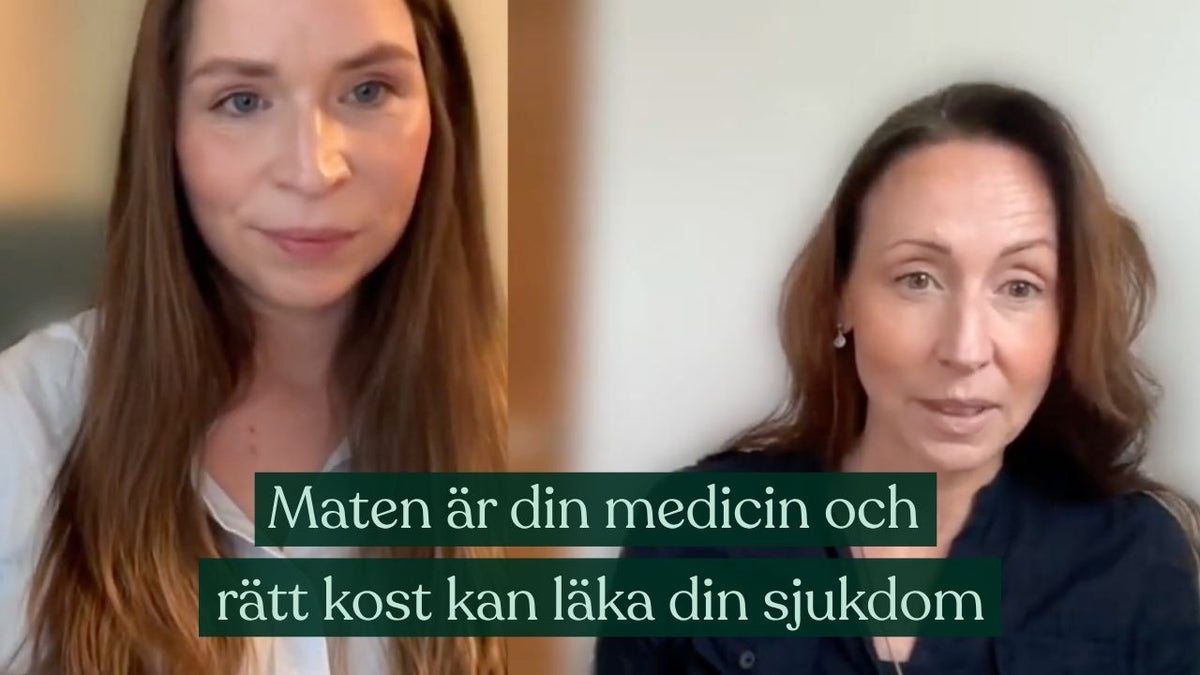
In the second episode of Hälsodjungeln, Glimja health expert Emma Köhn meets holistic health expert Therese Gillberg for a conversation about her own health journey, functional medicine, gut health, and how diet, stress, sleep, and lifestyle are connected. They also discuss why we sometimes make health more complicated than it needs to be, the importance of listening inwardly, and how small, simple changes can make a big difference to our well-being.
Watch, listen, or read - choose what suits you
🎧 Listen to the episode on Spotify
🎧 Listen to the episode on Apple Podcasts
Episode transcript
Emma Köhn, Glimja Health Expert (00:00)
Hello and a very warm welcome to a new episode here at Glimja. You may recognize me from before. My name is Emma, and today we are going to have a deep and very honest conversation about gut health, how to heal after a long period of illness and stress in life - and how everything in our bodies is connected.
With me today is Therese Gillberg, the person behind the website and account “Mat som medicin.” She works with functional medicine and a holistic perspective on health. We are delighted to have you here, Therese. You have had a long personal journey with ill health, which I think we should explore.
But first, would you like to tell us a little more about yourself and your background, which was not functional medicine from the very beginning?
Therese Gillberg, Holistic Health Expert (01:10)
Yes, thank you for having me here first. My background is that I started studying biomedicine right after upper secondary school. I have worked in healthcare in various capacities for 20 years.
I have always been interested in immunology. I started in blood transfusions, working with people who need blood during surgery - which blood bag is suitable for whom, and so on. Then I moved on to work with transplants, which was very interesting. There is only one place in Stockholm where this is done, so I worked there for ten years.
I worked on assessments before various transplants, such as bone marrow, liver, heart, and so on.
Emma Köhn, Glimja Health Expert (02:01)
Wow.
Therese Gillberg, Holistic Health Expert (02:02)
And then there are a great many details. Everything I have done has essentially been about looking at cells. Then I worked for eight years in cancer diagnostics, and that also involved microscopy. It is very much about: What happens at the cellular level? What does it look like?
Emma Köhn, Glimja Health Expert (02:16)
It has interested you?
Therese Gillberg, Holistic Health Expert (02:17)
Yes, I've been interested in it. So I did that for 20 years, really.
Emma Köhn, Glimja Health Expert (02:22)
Twenty years is still a long time. What I find so exciting about it is that you have a very traditional background and then, through your own journey, found your way into other areas. I imagine that gives you a completely different perspective too - having been on both sides.
Therese Gillberg, Holistic Health Expert (02:41)
Yes, exactly.
Emma Köhn, Glimja Health Expert (02:43)
But if we go into how you got into functional medicine?
Therese Gillberg, Holistic Health Expert (02:50)
Yes. As I understand it, it's quite common among others who work from a more alternative or holistic perspective to have their own journey. That was the case for me too. I became ill, quite seriously ill and very suddenly. I wasn't prepared for it at all.
I had never really had any problems before. No stomach problems or any other illnesses; it came on almost overnight.
Emma Köhn, Glimja Health Expert (03:20)
How? In what way?
Therese Gillberg, Holistic Health Expert (03:22)
For me, it was the joints, which I later found out was something rheumatic. For me, it actually started in a jaw joint. I didn't even think of it as a joint, but eventually I couldn't open my mouth. I couldn't eat, and the jaw joint fused shut, which I didn't know it could do either.
If you have inflammation in one place, tissue, cartilage, and bone break down, and then the body tries to support the area, causing various things to form. You have to try to support the body, so to speak.
But the problem became that I couldn't open my mouth, so I had to have surgery to open up the jaw joint. Then it was really five years of escalating problems, I would say. Different joints at different times. It comes in flare-ups.
It was both wrists, my knee, a toe, my neck - periods when I couldn't move my neck. Really, it was everywhere.
Emma Köhn, Glimja Health Expert (04:21)
And this started after you had your third child?
Therese Gillberg, Holistic Health Expert (04:25)
Yes, exactly.
Emma Köhn, Glimja Health Expert (04:26)
So, in the middle of life with young children. How... did you get signed off sick?
Therese Gillberg, Holistic Health Expert (04:36)
Yes, I mean, I was immediately signed off sick because I couldn't do anything. I could barely change diapers. With my wrists... You know, small children - you can't lift them.
That's how I noticed it too: Help, I can't hold her. I was afraid to hold her as well. She was only eight weeks old when it started, so she was very small. I also had two other children to take care of.
So I was signed off sick, which in a way was good because I could save my parental leave days. If you look at it positively. But at the time, I wasn't really thinking about that. It was secondary.
It also helped that my husband was able to stay home a lot and help. We basically had to rearrange everything.
Emma Köhn, Glimja Health Expert (05:27)
What was healthcare like then? Because this started in 2009, I think.
Therese Gillberg, Holistic Health Expert (05:33)
Yes, exactly. It was 2009.
What can I say? I suppose I took the traditional route. It was very severe, so it took a few weeks before I got to a clinic. Before that, they sent me to the emergency department every time. During the first two weeks, I was at the emergency department every other day.
But then they realized it wasn't going to go away. It was too severe and aggressive. So I was referred to a rheumatologist fairly quickly.
The thing was that I was breastfeeding, so I couldn't take just any medication.
Emma Köhn, Glimja Health Expert (06:11)
No, of course.
Therese Gillberg, Holistic Health Expert (06:12)
So I was given milder alternatives at first, but eventually they didn't help at all. I was eventually given corticosteroids despite breastfeeding, and they helped initially, I should say.
Emma Köhn, Glimja Health Expert (06:29)
Exactly.
Therese Gillberg, Holistic Health Expert (06:32)
But I had to stop breastfeeding after... She was about six months old by then. Then they could move on to the next level of medication - methotrexate, which is one of the first medications you get to suppress the immune system.
Emma Köhn, Glimja Health Expert (06:55)
As a first resort, so to speak. It might help.
Therese Gillberg, Holistic Health Expert (06:59)
It didn't help me particularly well at all. People respond very differently to medications and things like that. But very little actually helped me.
Emma Köhn, Glimja Health Expert (07:10)
No.
Therese Gillberg, Holistic Health Expert (07:11)
Next came biological medications, when you have to inject yourself. The first one I was given helped a little, for a while.
But I've also heard about them - from customers I have and others I've spoken to - that some things work for a while and then you have to switch. So you kind of get caught up in a carousel of testing: changing brands, changing models, and so on.
Emma Köhn, Glimja Health Expert (07:37)
But I also think that you, given your background, may have a different understanding of what it does to the body.
Therese Gillberg, Holistic Health Expert (07:48)
That was probably the thing for me. As a natural scientist, I went in there thinking that I really was in the right place. I was at the clinic where they were specialists in my problems.
So on the one hand, it was very difficult for me to seek help elsewhere and look around, because I really thought I was in the right place and would get help. I was very...
But over the years, when I also noticed that it wasn't working and that it wasn't helping, and with the knowledge of what the medications actually do - because I was taking all those medications, maybe six or seven in total, at the same time. Different things.
Emma Köhn, Glimja Health Expert (08:32)
Was it for different symptoms, all six or seven?
Therese Gillberg, Holistic Health Expert (08:38)
No, it was inflammation in various ways. Then, of course, there was Alvedon, which is more of a painkiller, and morphine-based medicines sometimes, when I really couldn’t move at all.
But all the others - corticosteroids, anti-inflammatory drugs, methotrexate, and the injections - were intended to suppress the immune system.
Emma Köhn, Glimja Health Expert (08:58)
How were you feeling, putting aside - difficult to put aside the rheumatism, of course - but the chemotherapy didn’t help. How did it affect the rest of your body? Did you develop any other problems as a result?
Therese Gillberg, Holistic Health Expert (09:17)
Yes, I mean, what I noticed was my appetite and things like that. You also feel that when you’ve had severe inflammation, you’re not in good shape overall. It’s as if your whole body is almost burning from the inside.
Pain is also so exhausting because you can’t think it away. When you’re in constant pain, it doesn’t matter whether you try to watch TV or sleep. It’s like a needle constantly prodding you.
The medication as well. I lost my hair from the chemotherapy, of course, and it became thinner. You absolutely must not become pregnant, so your entire cycle, menstruation, and things like that become completely disrupted.
That was probably the main thing. Then there were my nails and various other things, really. The body isn’t in a healing phase, but rather in a phase of breaking down, I would say.
Emma Köhn, Glimja Health Expert (10:18)
And what about the mental aspect? This went on for quite a few years, after all. It affected you as a person and your family, I imagine.
Therese Gillberg, Holistic Health Expert (10:34)
Exactly.
When someone is ill - I’ve thought about this a lot - it’s not just about me. I was the one who received help when I sought medical care, but an ill person may affect 20 people around them.
I also think about the children, my husband, and my mother, who was here a great deal and helped out. Going outside with a stroller. My job, which I couldn’t go to. You lose everything.
What I longed for most were everyday things like the freedom to drive, go shopping, go outside, or simply be able to see.
I remember so clearly sitting on the sofa at one point, unable to move. You sit there and see that you have three children. There are toys and things everywhere, and part of me just wanted to go and pick everything up and clean. But I couldn’t.
So, in a way, it was about accepting your situation. But there was frustration and grief over not being able to do it.
Emma Köhn, Glimja Health Expert (11:36)
Mm.
Therese Gillberg, Holistic Health Expert (11:38)
But then I think that you have - or I should say, I don’t know if everyone does - but during an illness, it was very clear to me that I didn’t sink into despair either. It becomes a matter of survival.
I didn’t delve into the emotions. I wasn’t really thinking about everything I’m talking about now back then. If I had delved into that as well, I was afraid I would become depressed or anxious, or that it would get even worse.
Emma Köhn, Glimja Health Expert (12:07)
Exactly.
Therese Gillberg, Holistic Health Expert (12:08)
We probably subconsciously try to deal with what we have and survive it. Then the healing processes usually come afterwards, once you've been through something.
When the body can relax, things can come up that you have otherwise kept at bay.
Emma Köhn, Glimja Health Expert (12:24)
Exactly.
Therese Gillberg, Holistic Health Expert (12:25)
During the process, I didn't really have many thoughts like that; they come more afterwards.
Emma Köhn, Glimja Health Expert (12:31)
I think many people can relate to that. I relate to it very much myself. I haven't been ill in that way, but I do have my epilepsy, which is constantly present.
It's only now, after being seizure-free for several years, that I can look back and say: How did I actually manage?
All those things that many people take for granted - the everyday things that nevertheless become limitations. I've never been able to drive, for example. Being productive at work on certain days. Things your friends do at a certain age, which you really want to join in with, but can't.
I haven't had constant pain in my body that physically stops me, but I can still relate to the feeling. I think a lot of people can.
It's these little everyday things that we really take for granted. That's what you miss the most. I imagine for you, not being able to play with your children in the way you would have wanted.
Therese Gillberg, Holistic Health Expert (13:42)
No, exactly. It meant not being able to attend school end-of-term celebrations or performances when there were things happening at school.
Emma Köhn, Glimja Health Expert (13:52)
Yes.
Therese Gillberg, Holistic Health Expert (13:53)
And so many other things. Several times I know I made plans because I wanted to so badly.
One side of me, when I look back, was incredibly stubborn. So it almost became a matter of trying to pretend that I wasn't ill.
Emma Köhn, Glimja Health Expert (14:05)
Yes.
Therese Gillberg, Holistic Health Expert (14:06)
I know I went to the cinema once, but my knee was almost twice its normal size.
I limped off, and I couldn't sit in the cinema seat either, because I'm quite tall - I'm 1.80 metres - so I barely fit anyway. But with this knee, I had to sit at the very end of the row with my leg stretched straight out into the aisle.
It was like this: I'd said I was going to go out for dinner and to the cinema with these friends. So I could walk.
Emma Köhn, Glimja Health Expert (14:30)
You were in a wheelchair for a while; it was that bad?
Therese Gillberg, Holistic Health Expert (14:33)
Yes. I mean, towards the end it settled in the sacroiliac joints, as they're called. Really at the very bottom of the back.
When it was like that, I couldn't walk. It wasn't a matter of, "Should I go to the cinema or not?" No, I couldn't. My whole body just... I couldn't do anything.
So then I really had no choice anymore. But there were several times before when it was like this: I could still, if I really… Because I wanted it so badly.
Emma Köhn, Glimja Health Expert (15:02)
Sometimes you just want to be yourself.
Therese Gillberg, Holistic Health Expert (15:04)
Yes.
Emma Köhn, Glimja Health Expert (15:06)
What was the support like from your friends? Was there a lot of understanding?
Therese Gillberg, Holistic Health Expert (15:14)
I also think that maybe I didn’t fully share everything, actually, when I look back. I pretended quite a lot. It wasn’t that bad.
Emma Köhn, Glimja Health Expert (15:25)
Yes.
Therese Gillberg, Holistic Health Expert (15:27)
But the people close to me understood. They sometimes came to my home when I didn’t have the energy to go. And my family has been incredibly supportive. The people close to me helped and drove me.
Every time, every appointment and X-ray, and when I was hospitalized. I’ve been hospitalized several times too.
Emma Köhn, Glimja Health Expert (15:49)
How old were you?
Therese Gillberg, Holistic Health Expert (15:53)
Should I count? How old could I have been? I must have been 31 when it started.
Emma Köhn, Glimja Health Expert (15:58)
That’s very young. What was the response from the healthcare system? Did you get any hope that you could do something yourself to make it better?
Therese Gillberg, Holistic Health Expert (16:13)
No. I asked if there was anything I could do, and there was nothing that could be done. When I Googled 1177 and all the usual places, it said that it was chronic.
Emma Köhn, Glimja Health Expert (16:25)
Mm.
Therese Gillberg, Holistic Health Expert (16:28)
For life. Several doctors also said: “You have to learn to live with the pain.”
Then I changed hospitals, because I thought, now I’m changing hospitals and doctors. But the first thing he said was the same thing: “You have to learn to live with the pain.”
So then I switched back to where I had been, because there was no point.
Emma Köhn, Glimja Health Expert (16:49)
I don’t think they realize how much weight their words carry.
Therese Gillberg, Holistic Health Expert (16:54)
No.
Emma Köhn, Glimja Health Expert (16:56)
How you are as a person, too. Now, you’re obviously a stubborn fighter who has managed to find other ways. But it’s often precisely this - being labeled as chronically ill. It can become an identity.
Therese Gillberg, Holistic Health Expert (17:11)
Absolutely. I think so too.
And it’s not that you enjoy the pain or your illness, but I’ve also noticed that some people can use it sometimes when they don’t have the energy to do things. Then I could use it as an excuse: I can’t. I’m sick, I’m in pain. When I actually didn’t want to do things.
I actually remember a period at the beginning.
When you’re given those biological medicines, how they’re stored is very important. And if you were traveling, you got a small cooler bag. That made me feel… I remember this, I felt a little special.
That was a side of me that was like: “Oh my God, I’m so sick and have so many things, so I have to have my own bag when I travel with it.”
But then when I got out of it, I thought: But that's not what I want.
Emma Köhn, Glimja Health Expert (18:00)
I don't think many people talk about that.
Therese Gillberg, Holistic Health Expert (18:07)
I understand that too. But I notice it in various forums I'm part of. I've been thrown out of various Facebook groups when I've said things.
Some people really make it part of their identity. They say to themselves: There's nothing I can do, that's just the way it is.
Then you feel reassured that you don't need to change your diet, you don't need to look at your life, you don't need to review your stress levels. You don't need to do anything, because that's just how it is.
I completely understand that, and I'm not someone who judges. You get to choose for yourself, I think.
Emma Köhn, Glimja Health Expert (18:37)
Absolutely. I recognize that from when I started looking for alternative approaches to epilepsy. I still joined a few forums because I didn't know anyone else who had it.
There was a lot of “there's nothing you can do about it, you just have to switch medications or add more medications”. I quickly felt that this wasn't for me.
I haven't been kicked out, because I didn't make a post. But I left them immediately because I felt that this would bring me down if I thought that way.
Therese Gillberg, Holistic Health Expert (19:30)
Yes.
Emma Köhn, Glimja Health Expert (19:32)
But if we move on to what actually started to help. That's much of what we're going to talk about. How did one thing lead to another? How did you get into that?
Therese Gillberg, Holistic Health Expert (19:45)
At that point, it was actually a medication, because in the end there was nothing that helped, not even the biologics. The final step was to be referred to some kind of day unit.
Then you get admitted once every three months, I think it was, and receive medication intravenously. Then you have to stay and be monitored with your heart and everything, because it's very potent. Things can happen, quite simply, so you have to receive it in hospital.
I was referred there, and I had the room at the very end of the corridor. I had to walk through the entire corridor. When I had my appointment at the day unit and saw people lying there, I looked into rooms and saw people lying there with tubes in their arms.
Somewhere around then... This is really ingrained in me now. I'll never lie down there.
It was so clear and obvious. It was obvious to me.
Emma Köhn, Glimja Health Expert (20:48)
What a relief.
Therese Gillberg, Holistic Health Expert (20:49)
Yes, but also scary.
I haven't had very good experiences with certain doctors lately, who started scolding and yelling at me. Eventually, I had to bring someone with me because I didn't want to go alone. Sometimes my husband came with me, sometimes my mother.
I couldn't say that I didn't want to take it either. Now I say so, but I had to play along for a while.
Because they threatened that I wouldn’t be granted sick leave if I didn’t do as they said. One side of me was like: I have to play along and say I’m going to do this just to have some kind of income at all.
Emma Köhn, Glimja Health Expert (21:34)
But did they shout because you didn’t want to take certain medications?
Therese Gillberg, Holistic Health Expert (21:40)
No, I think I was just unlucky too. I met some doctors who perhaps weren’t having a good day or maybe didn’t like their job. I don’t actually know.
But I had asked several times: Is there acupuncture? Is there anything else? And then they laughed at me. In the end, it was just: No.
It wasn’t a very good reception, really.
Emma Köhn, Glimja Health Expert (22:06)
I think all doctors fundamentally want to help. At the same time, it must be very frustrating to work in a profession where you never really have time for a patient. That may somehow make you less inclined to help over time.
But also - they have their own teachings. What they are taught about what is right and wrong. Some are more open-minded than others, I’ve noticed at least.
Therese Gillberg, Holistic Health Expert (22:41)
Yes, exactly.
Emma Köhn, Glimja Health Expert (22:42)
You shouldn’t be treated that way regardless. Okay, so you played along.
Therese Gillberg, Holistic Health Expert (22:50)
Yes. Then I really wanted to give it the summer, because this was in May. I had already made up my mind and read quite a lot about the importance of diet. I had found others who had healed and recovered.
So I said that it had improved and asked if we could wait until August, after the summer, and see. If it turns around, of course I’ll do it, but can we just see how it goes?
That was my plan.
Emma Köhn, Glimja Health Expert (23:29)
Okay, what did they say then?
Therese Gillberg, Holistic Health Expert (23:31)
You can’t really be forced. You have free will, even when it comes to medication.
Emma Köhn, Glimja Health Expert (23:37)
But you had to remain on sick leave?
Therese Gillberg, Holistic Health Expert (23:40)
I did.
Emma Köhn, Glimja Health Expert (23:46)
Did you start out with a specific diet?
Therese Gillberg, Holistic Health Expert (23:50)
Yes, exactly. It started with me looking for people who had recovered, and I found them. The whole field of functional medicine was a completely new door to walk through.
It was a completely new reality where doctors don’t just see a symptom that becomes a diagnosis and a treatment, but ask: We have a symptom - what is causing it?
Emma Köhn, Glimja Health Expert (24:16)
Exactly.
Therese Gillberg, Holistic Health Expert (24:17)
Or perhaps the opposite, really: How does it work?
Then I did my research. I’m the kind of person who wants to know and delve into the details. For about six months, I basically listened to podcasts nonstop, because everything was really out there - books, lectures, and all that.
What most people were talking about then was the gut. It was quite a hot topic. It was sometime around 2013-2014.
It was fairly new, but there was an enormous amount of research and studies. It also described exactly how the diet affects you, what happens in the gut, the connection to the immune system, and all of that.
Emma Köhn, Glimja Health Expert (24:58)
Yes.
Therese Gillberg, Holistic Health Expert (24:58)
So when I eventually discovered that there was some kind of solution and explanation that I could also use, it gave me hope. I don’t think you should underestimate that when you’re ill either.
Going from there being nothing you can do to discovering that there may be hope - what that does to our nervous system and healing cannot be measured, so we don’t know. But I’m convinced it has an impact too.
Emma Köhn, Glimja Health Expert (25:26)
Definitely. I’m completely convinced of that.
2013-2014, that was still some time ago. A lot has happened since then. Today, I feel that even functional medicine has become a bit of a jungle.
How did you experience it then? Was it fairly one-track at the time, or had it branched out?
Therese Gillberg, Holistic Health Expert (25:50)
I hadn’t thought of it that way, but it was quite logical. The people I found were people whose reasoning made sense to me.
In short, the doctors and clinics in the US, England, Australia, and so on said that they always start with diet, no matter what the issue is.
We know it’s good and clean, and that you get what you need. Then you can move on and test more things, measure the gut microbiome, hormones, toxins, and all sorts of things.
But I didn’t have the option of getting on a plane and going somewhere. Not financially, but practically either.
That’s how it happened: If diet is so important, and they say that’s where they start anyway, then I can start with that myself. I don’t need to go there. I can start there.
Emma Köhn, Glimja Health Expert (26:46)
So you did six months of research before that...
Therese Gillberg, Holistic Health Expert (26:49)
Yes, exactly. Then I found a specific diet program that made sense and seemed very logical to me.
Therese Gillberg, Holistic Health Expert (27:02)
It’s called SCD, Specific Carbohydrate Diet, which is specifically for gut healing.
Emma Köhn, Glimja Health Expert (27:10)
Mm.
Therese Gillberg, Holistic Health Expert (27:11)
On one side, I had the doctor saying that the gut is important for the immune system and autoimmunity, and on the other side there was a program that heals the gut.
Okay, if I combine them - what actually happens then? That’s what I did.
Emma Köhn, Glimja Health Expert (27:24)
But you did it on your own?
Therese Gillberg, Holistic Health Expert (27:26)
I did it on my own and bought the recommended books. I printed out food lists, put them on the fridge, and took photos of them on my phone so I had them with me when I went shopping.
Then you learn fairly quickly. I knew: This is good, I shouldn't have this.
It happened fairly quickly. I can say now, looking back, that I was very stubborn. There was no one who could tempt me with anything. I was so dedicated.
And there was a feeling that not only did I have to give it a chance, but I think some part of me also knew that it would work somehow. Unconsciously.
Emma Köhn, Glimja Health Expert (28:05)
I think that's necessary too, because right there at the beginning, if you're actually going to succeed, you can't make a lot of exceptions.
Therese Gillberg, Holistic Health Expert (28:14)
No, exactly.
Emma Köhn, Glimja Health Expert (28:18)
And once you know that and go all in. But how did it work with... I imagine many people listening also have young children, and perhaps some don't have a partner who wants to eat exactly that way or children who are picky eaters. How did that part work? Did you eat the way you did and let them eat whatever they wanted?
Therese Gillberg, Holistic Health Expert (28:40)
The thing is, it's actually a little paleo-inspired too. It's real food, clean food. It's not anything strange.
It's not as big a deal as people want to make it. People often turn changes into a huge deal. But really, if you just think that you eat naturally and cleanly, and what is available to gather - perhaps evolutionarily, I think - then it's not strange.
But of course, sometimes we did... If I made certain dishes, I could supplement them with rice or pasta, whatever. At school, they ate as usual when they were away.
It was only at home that things were perhaps a little different. But they were also quite young then, so it wasn't anything that... They basically had no choice. They had to take things as they were, really.
Emma Köhn, Glimja Health Expert (29:38)
Exactly.
Therese Gillberg, Holistic Health Expert (29:39)
Another challenge I've noticed among my clients is other people's comments. I almost think that can be even worse.
Emma Köhn, Glimja Health Expert (29:49)
You recognize that one. “Oh my God, what is he eating?” “I feel sorry for him because he doesn't get any sugar.” All kinds of comments you can get.
But it's a bit like you say - if you're just dedicated and convinced yourself, not much can sway you.
Therese Gillberg, Holistic Health Expert (30:12)
No.
Emma Köhn, Glimja Health Expert (30:13)
But now, as we mentioned, it was still several years ago. I think the big difference today is that there is just so much information.
When social media exploded, it hadn't really done so in the same way in 2013. Many people feel that this is exactly where it becomes so confusing. One person says one thing, another says something else. There are a lot of extremes.
But just as you say, it can be simplified a lot and really just go back to basics. People make it bigger than it is.
But did you feel that all the research and searching for health could become a source of stress in itself? Or was it just a leap?
Therese Gillberg, Holistic Health Expert (31:03)
No, I mean, maybe I'm different in that regard, I don't know. Because once I found my solution somehow, and explanations that were logical to me, that was enough.
I didn't really need to look any further. Maybe that was how it was before I found it. There was a period when I was active in various forums: “This supplement!” Then I bought it and tried it for maybe a few days or a week. No, it doesn't work.
So I moved on to the next one, and then I started searching into that. I can really relate to that. Different therapies - I've tried all sorts of different treatments before.
Emma Köhn, Glimja Health Expert (31:41)
Can you mention a few?
Therese Gillberg, Holistic Health Expert (31:44)
I tried frequency medicine, I've had healing, colon cleansing, and acupuncture. What else have I done? All sorts of different things, massages, lymphatic treatments.
But then there were a huge number of supplements. I had a whole box with different pills, jars, and minerals.
Different protocols, parasite cleansing - there's a whole world out there, really. I've also been down that rabbit hole, or whatever you want to call it.
But I didn't do it in a dedicated way, and I wasn't well-read. Back then, it was more a matter of taking something because someone said, “It worked for me,” and then I tried it.
Then it became a spiral where I didn't really know what was connected or what suited me. I didn't look inward and ask myself: Do I believe in this? What is it based on?
It was really just an outward search.
Emma Köhn, Glimja Health Expert (32:44)
I think that's very common. Especially when you read everywhere: Take this and take that.
It's also quite difficult to measure. Let's say a multivitamin or some more specific supplement. They can absolutely be relevant to take, but sometimes you may be taking it simply because you don't really know why.
How long did it take before you started noticing a difference? In the end, did you rely solely on the diet?
Therese Gillberg, Holistic Health Expert (33:23)
Yes. When I found it, I actually stopped taking everything else.
The only other thing I did at the same time was take Epsom salt baths, which contain magnesium and can have a muscle-relaxing effect, and take cod liver oil. I think those were the only supplements, if we're talking about what I did at the time, apart from the diet.
But it took three months until I was completely symptom-free.
The tests were also normal, because I had a follow-up after the summer. So that's why I can connect the two and remember.
Emma Köhn, Glimja Health Expert (33:59)
Three months. That's fast.
Therese Gillberg, Holistic Health Expert (34:01)
Mm.
Emma Köhn, Glimja Health Expert (34:03)
So impressive. Symptom-free - all pain gone, no wheelchair. I don't know what other symptoms you had.
Therese Gillberg, Holistic Health Expert (34:13)
My joints were very swollen, because it wasn’t just a little inflammation. When I had the inflammation, you could see the swelling and increased warmth, all the signs.
So it disappeared. I could see my tendons again. Other people may not think about it, but we often have visible tendons on our hands. They had disappeared for me because there was nothing but swelling.
Then I noticed that I was beginning to see these tendons. I started to see my wrist, my legs. I hadn’t seen them.
Those were the signs I noticed. But something else I’ve thought about in hindsight is that when things start to turn around and you begin to heal, it’s not as if you wake up and everything is gone. It happens in tiny, tiny steps.
So maybe I wasn’t very observant that summer either about what was happening. Suddenly it was August.
I had a doctor’s appointment, had given blood samples, and she said, “But you’re not swollen.”
I was just like, “No, that’s right.” The test results were good. She had to remind me that it was actually gone. It was a little strange.
It’s something I really encourage the people I work with to do now: write down your symptoms on a scale so you can track your progress. The greatest motivation is being able to look back four weeks.
“Shit, my swelling was an eight, I was in pain at a ten. I slept badly.” And then you can see that it’s only a four now.
It becomes a kind of motivation to realize that you’re on the right track.
Emma Köhn, Glimja Health Expert (35:41)
God, yes.
Therese Gillberg, Holistic Health Expert (35:42)
That’s not what I did. I just went for it, really.
Emma Köhn, Glimja Health Expert (35:46)
It must help that you’ve been through it yourself, so you know how you can help your clients in a completely different way.
Therese Gillberg, Holistic Health Expert (35:52)
Yes.
Emma Köhn, Glimja Health Expert (35:55)
Then you continued your education. You left the traditional...
Therese Gillberg, Holistic Health Expert (36:02)
Yes, quite quickly, actually. I started a nutrition counselor course that I found. It was partly distance learning, but we also met in person. Maybe it was four months or something.
Then I really started Food as Medicine. My Instagram dates back to 2015.
Emma Köhn, Glimja Health Expert (36:28)
Do you still have everything from then?
Therese Gillberg, Holistic Health Expert (36:30)
I think that if you scroll back, my very first posts are at the bottom.
But I stayed on because I couldn’t quit. I hadn’t started anything yet, so I worked a bit on weekends and evenings and perhaps held a course now and then.
I stayed at my regular job until the end of 2018. Then it was goodbye - I went into Food as Medicine full-time.
Emma Köhn, Glimja Health Expert (37:02)
Yes.
It feels like an expression that is used quite a lot today, at least from what I’ve experienced on American podcasts and so on. But what does Food as Medicine mean to you today?
Did you follow this protocol strictly, or how has it evolved?
Therese Gillberg, Holistic Health Expert (37:25)
No. As I see it, the idea behind such protocols is that they are used for a shorter period to restore balance, heal and find some kind of balance in the body.
Then the idea is to reintroduce foods that you may have initially removed.
Today, it’s something completely different for me. Clean, natural and unprocessed foods can take you a long way. Most people actually don’t need to follow stricter protocols.
Emma Köhn, Glimja Health Expert (38:07)
What issues do your clients come to you with today?
Therese Gillberg, Holistic Health Expert (38:13)
I would say there are a lot of autoimmune issues. There have also been a lot of rheumatic conditions. Maybe they’ve read about me or seen me in some magazine or something.
Hormonal imbalances are also very common now. Most of the people who follow me are women, as are most of those who contact me.
Emma Köhn, Glimja Health Expert (38:38)
Exactly.
Therese Gillberg, Holistic Health Expert (38:40)
They’re about my age and have a bit of…
But the thing is, people have also now understood that everything is actually connected in one way or another.
If you have skin problems, autoimmune or hormonal issues, there’s a connection to the gut in one way or another, and to your diet. I would say it’s essentially some kind of key to whatever you may be dealing with, and you can work from there.
Emma Köhn, Glimja Health Expert (39:07)
We were going to get into that a little too. Now we’re moving into it. How everything is connected.
Before we started recording, we talked about how people don’t really live… don’t listen to themselves today. The gut is of course a huge part of it. But what else would you say people need to change?
Therese Gillberg, Holistic Health Expert (39:39)
I feel like I see… Maybe I wasn’t really that focused on it either, but it has become so mainstream. Stress, I think, is…
You don’t know which came first, the chicken or the egg, either. Stress affects the gut flora, the bacteria and the intestinal wall. And the balance too. We may never even find out what is what or where it begins. Maybe it doesn’t really matter either.
As I see it, when you just look at what society is like, how we function and how we live, I think stress is a much, much bigger cause than we may want to see or understand.
You can really clearly see it in people who do everything, I would say. I’ve had many people who truly go all in and are so diligent.
It’s the purest, finest food from farms; everything is so strict and you stay within your limits. There are supplements if you’ve measured everything possible.
All the tests for gut flora, infections, hormones, and yet they still don’t get all the way there.
Emma Köhn, Glimja Health Expert (40:51)
I think it’s very common. Because no matter how noticeable the stress is, it’s still the norm today. Maybe we don’t really want to reflect on it, because then we would have to change so much and truly reassess our lives.
The mental aspect is probably the hardest too. You can't really touch it. It's easier to make all the other concrete changes and measure them and all that.
I'm definitely guilty of it myself. I'm not sitting here judging anyone, and I'm probably still there myself, actually.
But if you think of a few small, simple changes people can start with - when people come to you, what do you advise them to do? I know everything is individual, but...
Therese Gillberg, Holistic Health Expert (41:38)
It's actually interesting too, because it can be so incredibly different.
I sometimes offer free consultations, just if someone wants a little check-in with me: Who are you? Can you help me in some way?
I've really seen the whole range. There have been people who, in 20 minutes, actually see and understand that stress is the problem.
Wow. Then maybe I'm not... Then I'm not the person who should help them.
But then it's other people, perhaps a therapist, or maybe you just need to reduce your working hours, reorganize things, or ask yourself: What am I really doing? Am I even doing what I want with my life?
There can be so many dimensions to it.
Whereas other people often already know. Sometimes it may be enough just to have confirmation that they're on the right track.
Emma Köhn, Glimja Health Expert (42:31)
Yes.
Therese Gillberg, Holistic Health Expert (42:32)
They're just like: “I needed to hear someone say what you said. I needed to hear that I should keep going.”
Because they've already read everything. They have all the books and protocols and actually know everything. They just need one small piece of the puzzle to keep going.
Emma Köhn, Glimja Health Expert (42:49)
It can also be helpful to hear someone else's opinion, to get a nudge to make changes in your life.
The people around you aren't always supportive or understanding. Then you start doubting yourself and stop listening to yourself and your gut feeling.
Therese Gillberg, Holistic Health Expert (43:09)
And it can take time too. You may have already started and be completely on the right track, but it's only been two weeks.
If you think you should already be feeling a change... Then maybe you've been ill for 30 years.
Emma Köhn, Glimja Health Expert (43:23)
Exactly.
Therese Gillberg, Holistic Health Expert (43:24)
Then maybe it's simply a matter of this: Be a little patient, trust the process, and trust that your body knows what it's doing.
If you give it everything it needs now to feel well and be in balance - diet, stress management, sleep, exercise, and addressing nutritional deficiencies - you also have to let the body use those building blocks. It takes longer.
Emma Köhn, Glimja Health Expert (43:46)
Yes, because you may have become ill 30 years ago, but you may have started becoming ill without symptoms 40-50 years ago.
Therese Gillberg, Holistic Health Expert (43:55)
Exactly.
Emma Köhn, Glimja Health Expert (43:57)
It's super interesting. I'm particularly curious about stress, given your expertise - how does stress affect our digestion and the rest of the body? What do we really know?
Therese Gillberg, Holistic Health Expert (44:13)
I mean, we know everything too. That's what's so fascinating once you really look into it, and anyone can basically read about it.
Stress affects everything, every single cell.
Emma Köhn, Glimja Health Expert (44:23)
Yes.
Therese Gillberg, Holistic Health Expert (44:24)
When we talk about what I worked with the most, perhaps diet and nutrition as a whole and the gut, stress, as you said, affects the entire digestive system. Everything and every part of digestion.
From saliva production, which decreases, to stomach acid, which is needed to kill pathogens and start digesting food so we can absorb nutrients. It decreases.
Bowel movements are affected, as are nutrient absorption and the enzymes needed from the pancreas - everything. And bile.
Emma Köhn, Glimja Health Expert (44:53)
There are no enzymes or probiotics in the world that can help you if you don't make any other changes.
Therese Gillberg, Holistic Health Expert (45:00)
Exactly.
Emma Köhn, Glimja Health Expert (45:01)
It can be a really good supplement.
Therese Gillberg, Holistic Health Expert (45:04)
Yes.
Emma Köhn, Glimja Health Expert (45:05)
But the foundation has to be there.
Therese Gillberg, Holistic Health Expert (45:07)
Exactly. You can eat really well, take supplements, and do everything. But if you're constantly in a state of stress, meaning that the sympathetic nervous system is activated more or less all the time without recovery - how can the body heal?
It simply doesn't have the capacity for that.
Emma Köhn, Glimja Health Expert (45:27)
Let's pause there for a moment, because we want to make sure everyone understands: sympathetic, parasympathetic - fight or flight.
Therese Gillberg, Holistic Health Expert (45:36)
Yes. If you think of the sympathetic nervous system as what is activated when we're stressed. It's fight or flight, as it's called, or even freeze - you can become paralyzed.
I try to take the drama out of it, because it often turns into a discussion about one thing being bad and the other being good. No! We were born with them and have always had them. They're there to protect us.
If we're being chased, for example, then all of this is supposed to happen in the body. Digestion slows down because it's not important. Digesting food isn't a priority when you might be being chased.
Then you should run as fast as hell. Glucose levels should rise, the muscles should get energy, and your heart rate goes up. You know that when you get stressed about having to do something. You can feel your heart, it goes a bit like this.
And that's so we can run.
Emma Köhn, Glimja Health Expert (46:24)
You also get more focus. Give a presentation or do something that makes you really nervous - then you get a completely different kind of focus. Focus on being switched on.
But we can't be in that state all the time.
Therese Gillberg, Holistic Health Expert (46:33)
No. Balance is the problem. Balance in the gut flora, balance in our nervous system, and balance in our lives.
I think the balance is off - too much of one thing and too little of another.
Emma Köhn, Glimja Health Expert (46:50)
We’re not meant to achieve any kind of balance in today’s society. It doesn’t add up. There aren’t enough hours in the day.
Therese Gillberg, Holistic Health Expert (47:01)
No.
Emma Köhn, Glimja Health Expert (47:02)
People are talking a lot about screen time now, and something I can relate to, which you also mentioned earlier: You’re supposed to do everything perfectly when you want to become healthy.
Therese Gillberg, Holistic Health Expert (47:12)
Mm.
Emma Köhn, Glimja Health Expert (47:13)
Get up at five in the morning before your children to have time for yourself. Yoga, journaling. You’re supposed to eat perfectly and find time to work out so many times a week.
Preferably not just strength training, but also yoga and running, while at the same time being a present parent and a good partner. And finding time for yourself and performing well at work.
I think many people feel that it doesn’t add up.
Therese Gillberg, Holistic Health Expert (47:48)
No.
Emma Köhn, Glimja Health Expert (47:50)
That in itself is stressful. If you were to choose three things…
Therese Gillberg, Holistic Health Expert (47:58)
That you’re supposed to do?
Emma Köhn, Glimja Health Expert (48:00)
Just on a day-to-day basis. Maybe that’s the core of it. Some people may feel really good writing down their thoughts every morning. It’s highly individual.
But what does the body need? Daylight?
Therese Gillberg, Holistic Health Expert (48:18)
I mean, really, you could say - when you list everything there: Now there’s infrared, you can sit in a sauna… Everything is good in some way.
But do you have to do everything?
Emma Köhn, Glimja Health Expert (48:32)
No. I think many people find it difficult to sort through everything. Precisely because they don’t listen to themselves and what they need. They listen to everyone else - what the current trend is or what different people advocate.
It gets tricky, I think.
Therese Gillberg, Holistic Health Expert (48:50)
But I think that’s the problem - we don’t listen to ourselves. Then we don’t have to do everything. We can ask ourselves: What do I really want and need?
And it doesn’t have to cost anything either.
For example, do you love walking in the woods? Then it’s much more worthwhile to go out for 20–30 minutes. Maybe you even have a dog - go out for a walk.
Remove all the podcasts, remove all the calls. Don’t walk and talk on the phone at the same time. Just go out into nature if that’s what you enjoy.
And it’s free.
Emma Köhn, Glimja Health Expert (49:32)
I did it as a challenge to myself - no music, podcasts, or anything, just going out for a walk.
For me, walks have always had to count as exercise. It has to be fast-paced. I can’t just go out and stroll through nature.
I think that’s very common among people.
I discovered this: I feel best when I take a brisk walk. That’s what I find relaxing. I don’t know… I clear my head in a different way.
But doing it without any distractions was the difficult part. It was absolutely wonderful once you discovered that it was possible too.
Therese Gillberg, Holistic Health Expert (50:20)
Yes. And then I also think that if you forget or set aside everything you should do, or that you read about, and truly turn to yourself, you may find things you loved doing as a child.
Or: I want to start riding. I’m going to start crocheting or painting or playing an instrument. Whatever it may be.
Emma Köhn, Glimja Health Expert (50:43)
Yes.
Therese Gillberg, Holistic Health Expert (50:43)
I think that if you turn to yourself and do something you’re truly passionate about and love, where you also lose track of time and space and simply immerse yourself in it - there’s nothing more healing for the body.
Emma Köhn, Glimja Health Expert (50:55)
No. It doesn’t have to be movement, exercise, and performance. It can simply be something we genuinely enjoy doing.
Therese Gillberg, Holistic Health Expert (51:03)
And then this other system, the parasympathetic nervous system, is activated. Peace and quiet. That’s where we digest our food, and it’s also where the body can heal.
Emma Köhn, Glimja Health Expert (51:12)
What’s your thing? Or hobby, or whatever you want to call it.
Therese Gillberg, Holistic Health Expert (51:18)
I mean, yes. We bought a dog there in the middle of all that a few years ago, and I used to spend a lot of time walking in the forest and being outdoors too, actually. But now I do it even more.
For me, nature and the forest are truly so healing. But that’s not the case for everyone. Some people get stressed by it, and then you shouldn’t do it. You have to find something else.
Emma Köhn, Glimja Health Expert (51:45)
Something I’ve found so interesting recently, since I’m going to have my second child quite soon, is that I took a hypnobirthing course.
There’s a 20-minute meditation where they ask you to visualize a place that makes you feel calm.
Something that came to mind that was so unexpected was where I grew up, right in the middle of the forest. Thirty kilometers from any civilization, in the heart of Skåne.
I’ve always thought that I didn’t like growing up in the countryside, even when I was a horse girl and all that. It’s kind of far removed from the person I am today.
But it was the first place that came to mind. That particular forest, and riding across meadows without a bridle, saddle, or anything, which I had repressed.
That was kind of what came up. And that it actually is what calms me - I should explore that a little more.
Therese Gillberg, Holistic Health Expert (52:57)
Yes. And the thing is, too, when you put it that way, it becomes so clear.
If we never calm down or become still or turn inward, we don’t see that. Because it doesn’t emerge when you’re perhaps in the middle of your work or have a lot going on.
That’s what I mean: If we go in and find some kind of stillness, whatever it may be - swimming or going for a walk - but simply ask ourselves: What do I want? What am I doing?
Exactly. That's when you find these answers that you don't find when the body is active and you have to perform and read and browse and scroll and everything else we do.
That's actually where many of the answers are, and the keys to your own healing.
Emma Köhn, Glimja Health Expert (53:44)
I also feel that these days, a lot is about constantly optimizing everything, even your everyday life. Life hacks to the right and left about how you can analyze everything.
It surely has its advantages in many ways. But we don't really need to do all that. We can also just be.
Therese Gillberg, Holistic Health Expert (54:07)
You may be able to eliminate 20, 30, 40 percent of what you do, because it isn't important.
That doesn't mean… I may not even want to do that. Then you have a lot of time. We all have the same amount of time.
Then I also think of another thing about really listening inward and finding your own keys: You move more in the right direction.
Because if we listen outwardly to others, we can run around and do all sorts of things. But if it's not for my own good, if we're thinking in terms of efficiency, then it's better to ask yourself: What do I need? What do I want? What am I passionate about?
Then you can move more directly in the right direction, instead of running like crazy in every direction.
Emma Köhn, Glimja Health Expert (54:50)
Exactly. It may be that you have a job you don't love, but you feel secure in it and it has many advantages. But then perhaps having a hobby on the side that is truly 100 percent yours.
Of course, it can help a lot if your job also feels better.
Not everyone is a career-oriented person who wants to aim really high. Maybe you just want to go to work, do your job, and go home, but perhaps you don't feel fulfilled all the time.
Then it can help to have something on the side that you're truly passionate about.
Therese Gillberg, Holistic Health Expert (55:35)
Absolutely.
Emma Köhn, Glimja Health Expert (55:36)
And really, that's preferable to having a… I think it’s like this: Many people strive for a huge career but aren't happy and don't have time for a hobby. That's terrible.
Therese Gillberg, Holistic Health Expert (55:50)
No, exactly. And what really matters?
Then you may start asking yourself those kinds of questions when you've been ill, for example, or are in the middle of something. To start asking yourself: What really matters? What…
Emma Köhn, Glimja Health Expert (56:04)
Exactly.
Therese Gillberg, Holistic Health Expert (56:05)
What am I doing? What do I want to spend my time on?
Maybe dare a little more too. Many people have dreams about what they would like to do.
But then the ego comes in, or thoughts, or other people saying: “Are you really going to dare to do that?”
Daring to follow what you might be passionate about and actually want to do too - I believe that makes a huge difference.
Emma Köhn, Glimja Health Expert (56:28)
Absolutely.
But this is precisely about breaking out of your comfort patterns. It's scary.
Therese Gillberg, Holistic Health Expert (56:38)
Mm, yes.
Emma Köhn, Glimja Health Expert (56:39)
There may be identity crises and all sorts of things along the way.
Therese Gillberg, Holistic Health Expert (56:44)
Exactly, but that's also where we grow.
Emma Köhn, Glimja Health Expert (56:48)
Absolutely.
Therese Gillberg, Holistic Health Expert (56:49)
You can take small steps. You don't have to change your whole life either.
It's the same with your diet. You don't have to change everything. It may be enough to replace one meal. How does that feel?
You can make small changes. You don't have to do everything.
Emma Köhn, Glimja Health Expert (57:05)
A lot of people talk about not focusing on what you have to remove, but on what you can add.
It can be a good way to help, precisely because it shifts the focus and doesn't involve a lot of prohibitions. Over time, you'll probably start preferring what you add. There will be more and more of it.
Therese Gillberg, Holistic Health Expert (57:27)
Yes, that's great.
Emma Köhn, Glimja Health Expert (57:31)
If we think about… Because not everyone gets rheumatism or, in my case, epilepsy. Instead, there are many vague symptoms that you can pay attention to.
Do you think, as I do at least, that the body is trying to tell us something when it's time to start thinking differently?
Therese Gillberg, Holistic Health Expert (57:55)
Maybe a little about what symptoms are, or like…
Emma Köhn, Glimja Health Expert (57:58)
Yes, and do you think the body is trying to tell us something?
Therese Gillberg, Holistic Health Expert (58:03)
It's also very interesting when you think about what symptoms really are, or as I see it - and it's not just me, but many people with a more holistic perspective.
The symptoms are really just little… I mean, the body is kind of calling out for help. I'm waving a little red flag. Something is out of balance. Please help me.
Something you're doing now isn't good for you. Stop doing something or start doing something else.
And often, as you say, there are many vague symptoms that a lot of people have and that you can't really… You try to figure out what is causing them and what you can do.
But since everything in the body is connected, it can sometimes be a little tricky to tell what is what. Just being stressed for a while and sleeping poorly can cause a lot of other symptoms.
So what is what… But if you get to the bottom of what a symptom is, I think that at the very least, it's something that needs to change.
Emma Köhn, Glimja Health Expert (59:02)
Exactly.
That's where the holistic perspective can really help, precisely because you look at the whole body. When you go to conventional healthcare, each body part is treated separately. They don't always look at the whole picture.
You might have migraines all the time, but it doesn't necessarily have to be in your head. I'm just using that as an example.
But I think there is a lot…
Now we were talking about stress, but I have friends around me who have a lot of sleep problems, tinnitus, stomach issues without any specific diagnosis. There are so many symptoms that people need help with.
It can be difficult to know where to start looking, because you can become very fixated on diagnoses. In other words, you feel you have to go to a doctor and be told that you have Crohn’s or IBS before you can start treatment.
But you don’t really have to wait for that. You can find help in other ways. All the information is available.
Therese Gillberg, Holistic Health Expert (1:00:19)
Yes, absolutely. Then I think it can be a good idea to rule out more serious conditions first before you start experimenting on your own as well.
So I tell everyone: First, go and check that it isn’t something else. But then it’s very, very common that you don’t find anything. You have problems. All the tests may even be normal, but you still feel unwell.
So the question is: What do I do now?
I see diet as a very accessible tool. Maybe just take a look at: What do I have at home? Is most of it in boxes? Is it packaged? Is it ultra-processed? Is there little color? Is there little variety?
That might be where a major key lies.
Emma Köhn, Glimja Health Expert (1:01:09)
Do you have any tips for when you go grocery shopping?
I know from my own experience - I know what’s good and what isn’t nowadays - but at first I thought you should stick to the outer edges of the store, where most of the fresh food is.
Therese Gillberg, Holistic Health Expert (1:01:26)
Exactly.
Emma Köhn, Glimja Health Expert (1:01:29)
There aren’t lots of packaged…
Therese Gillberg, Holistic Health Expert (1:01:30)
No.
Emma Köhn, Glimja Health Expert (1:01:31)
…things. Fruit and vegetables are usually in the middle, for that matter. If you eat animal products, they’re along the outer edge at the meat counters. Dairy products are also along the outer edge.
All the middle aisles…
Therese Gillberg, Holistic Health Expert (1:01:51)
Mm.
Emma Köhn, Glimja Health Expert (1:01:52)
There are good things there too that you’ll need. Buckwheat flour or something like that may be included as well.
And read the ingredient lists. If there’s a long list of ingredients, it’s usually not good.
Therese Gillberg, Holistic Health Expert (1:02:08)
Yes, but it’s also really good to keep in mind when shopping that you can see what you’re buying.
In other words, buy things where you can say: These are carrots, these are beets, this is fish, meat, eggs, nuts. I can see what it is. It doesn’t even need to come in a box. It doesn’t even need an ingredients list, because it’s 100 percent carrots.
That’s also a fairly good rule of thumb.
Of course, there are things in packages that can also be good. That’s not what I mean. But as you say - most packaged food is ultra-processed.
You have to remember that it wasn’t made for our benefit. It wasn’t made for our health. It was made to last a long time on the shelf.
Emma Köhn, Glimja Health Expert (1:02:49)
And that you should eat more of it.
Therese Gillberg, Holistic Health Expert (1:02:51)
Yes, that’s a fairly good rule of thumb.
Then generally, when it comes to color, I like that it also tends to make eating a little more fun. If you think about adding more colors to your plate, you automatically get more vitamins, more antioxidants and more different types of fiber.
In other words, you get everything. You don't have to think: This gives me this, and I need that. No.
If you have lots of different colors and perhaps something fermented or something raw, different textures and different colors - that will also take you a long way.
Emma Köhn, Glimja Health Expert (1:03:23)
It makes eating much more fun.
Therese Gillberg, Holistic Health Expert (1:03:26)
Mm.
Emma Köhn, Glimja Health Expert (1:03:29)
Of course you can crave something you used to eat. I can't tolerate gluten now, so I don't eat lots of bread, even though I used to love it.
But a crisp salad with carrots, mango, avocado and a little... That's the kind of thing.
That's right - correct me if I'm wrong - but you can change what your gut bacteria prefer?
Therese Gillberg, Holistic Health Expert (1:04:05)
Yes, absolutely. They only change when you eat differently. And it happens really fast.
Emma Köhn, Glimja Health Expert (1:04:11)
Yes.
Therese Gillberg, Holistic Health Expert (1:04:11)
Changes have been measured after just 24 hours. Because they live on what we eat.
You can think of it as not just eating for myself. I'm also eating for my gut flora, which weighs about two kilos. A whole universe of its own.
It's like a rainforest of everything. They all help one another and produce things for us, break things down for us and communicate with the brain. It's absolutely incredible.
Emma Köhn, Glimja Health Expert (1:04:38)
I read - I don't know which book - but I thought it was such an interesting approach.
Instead of thinking that if I were craving something I don't know is good for me... I'm not saying you should never make exceptions. If you want to eat it, eat it.
But if I were craving, let's say in my case, bread - to think that it's not me having poor willpower, but that it's actually my bad bacteria trying to survive right now and wanting to be fed exactly that, and that that's why I'm craving it.
I found that really helpful for understanding how it all fits together and why you get these cravings. It helps you make better choices, at least in my case.
Therese Gillberg, Holistic Health Expert (1:05:36)
Yes, absolutely. And since they also control metabolism and hunger and satiety signals, cravings can also mean that, as you say, they're being starved.
“Give me quick carbohydrates, give me this!”
And that's why you can also experience some symptoms when you stop taking things. A little die-off, meaning that these start to die off. Then they may cry out even more for certain things.
But it goes away when you change the balance. Then you feed the others instead, and it becomes balanced.
Emma Köhn, Glimja Health Expert (1:06:11)
I think it is incredibly exciting, because there is often some form of shame involved in not managing to persevere or resist things.
But if you actually understand how things are connected, it can be extremely helpful.
If someone is listening to this and recognizes themselves in much of what you have talked about, or even just a little - perhaps vague symptoms or a very serious diagnosis - and wants to... What would you say to that person? Where should they start?
Take my mother as an example. She finds it very difficult to read up on everything, partly because so much of it may be in English. And it is difficult to... Maybe you are not on social media and taking in all the information, or you do not know which books to turn to.
What is your tip for getting started?
Therese Gillberg, Holistic Health Expert (1:07:07)
I mean, really, I would say something like what we have talked about: adding good things.
Maybe clear out a few things at home first. Remove ultra-processed foods from the cupboards and start with curiosity. At the same time, connect it to your own body - notice how things feel.
Things like dairy products, gluten, wheat flour, sugar. Some people notice an effect after just a few days. They have more energy.
Emma Köhn, Glimja Health Expert (1:07:44)
It is so exciting.
Therese Gillberg, Holistic Health Expert (1:07:45)
It does not have to take very long, and the body responds fairly quickly. With what we eat in particular, things happen very, very quickly.
It is not dangerous to experiment on your own. If we remove wheat flour - what is wheat flour, really? We do without white bread, perhaps buns and a little fika. We will not die from it.
Then you may notice that you are not bloated. People who always go to bed feeling as though they are six months pregnant... I am always bloated, and it has become normal because it has been that way for so long.
And suddenly: “My God, I can button my trousers in the evening!”
Or lactose or certain dairy products. Some people may be sensitive to dairy products and sugar. Those are perhaps three of the things that have the greatest impact, and you may notice a difference if you are sensitive to them.
Emma Köhn, Glimja Health Expert (1:08:38)
It is important to know how many different types of sugar there actually are in everything.
The ingredient list also says glucose syrup and all sorts of other things. Actually turning the package around and reading it - becoming aware of what you are putting into your body.
Therese Gillberg, Holistic Health Expert (1:08:59)
Yes.
I think that is what gets you furthest. Then it depends on the challenges each person has.
Often, you may know that you are addicted to sugar. That is a huge issue, and in that case you may need another type of support as well.
For some people, knowledge is necessary. For me, knowledge was the key - an understanding that helped me move forward.
While others completely disregard it: “Tell me what to do and I’ll do it.” You don’t want to know why or how.
Even there, I would say that you really trust yourself and turn to yourself. What do I need?
I know I need knowledge, so I start reading this book and then I can get help.
For someone else, it may be more about recipes. Start following five accounts, try it for a week, and make your own plan or replace certain things.
Try something new too. Don't go to the same shelf again, as you may be inclined to do. You want to cook the same type of food and go to the same shelves. It's sort of ingrained.
Go to a different shelf.
Emma Köhn, Glimja Health Expert (1:10:07)
Then maybe don't try to make a substitute for what you already eat. Many people do that. They want their sandwich, so they bake it using something else.
It's the first time you've tried something like that. It doesn't taste at all the way you expect it to.
Therese Gillberg, Holistic Health Expert (1:10:26)
Yes, exactly.
Emma Köhn, Glimja Health Expert (1:10:29)
You need something completely new.
Therese Gillberg, Holistic Health Expert (1:10:30)
Yes.
Emma Köhn, Glimja Health Expert (1:10:32)
Something that feels exciting.
Therese Gillberg, Holistic Health Expert (1:10:34)
Yes, exactly. But it is a challenge.
I also think you shouldn't be afraid to challenge yourself. Dare to step outside what is uncomfortable or new.
Emma Köhn, Glimja Health Expert (1:10:48)
Yes.
Therese Gillberg, Holistic Health Expert (1:10:48)
Because what if the key is there? What if the healing is there? What if the symptoms disappear when I step outside my box?
And that's the only thing you really want. Then you've sort of found your way home, I think.
Emma Köhn, Glimja Health Expert (1:11:00)
That's what's so inspiring too, and I think you regain your power yourself.
You are not helpless, you are not condemned to be sick for the rest of your life.
Therese Gillberg, Holistic Health Expert (1:11:13)
No.
The feeling too, when you actually, as you say, do it yourself. I can't change anyone else. I can help them and provide tools and support, but you have to do the work yourself.
Emma Köhn, Glimja Health Expert (1:11:25)
Exactly.
Therese Gillberg, Holistic Health Expert (1:11:26)
But that's also the reward. When you feel better, you can also thank yourself.
I did this myself.
Emma Köhn, Glimja Health Expert (1:11:33)
And you have the knowledge and can continue on your own.
Therese Gillberg, Holistic Health Expert (1:11:37)
Yes.
Emma Köhn, Glimja Health Expert (1:11:39)
I'm thinking for those listening who want to get in touch with you: you have your website, Mat som medicin.
Therese Gillberg, Holistic Health Expert (1:11:46)
Mm.
Emma Köhn, Glimja Health Expert (1:11:48)
Where you have different types of programs and courses you can take, with different focuses. And you tailor them depending on the individual?
Therese Gillberg, Holistic Health Expert (1:11:59)
Yes, exactly. There are really two basic programs.
One that is a little stricter, which I call the Gut Healing Program. That's what I did, which is a little stricter. You feel that you may have major problems, and I have no problem being strict for a period.
Then I have the other aspect, which is more connected to stress, gut flora, and tools for balancing things from both sides. In other words, an anti-inflammatory diet, but also actually reviewing your habits, routines, and stress.
Because that's essentially been my focus when I've studied too - the connection between the gut and the brain.
Emma Köhn, Glimja Health Expert (1:12:42)
And you have your Instagram account, Food as Medicine.
Therese Gillberg, Holistic Health Expert (1:12:46)
Yes.
Emma Köhn, Glimja Health Expert (1:12:47)
I had a look. You post lots of tips and recipes and things that people can benefit from.
Therese Gillberg, Holistic Health Expert (1:12:53)
Yes, exactly. If you want to try something, just scroll through and try a recipe or learn something.
And then you can just contact me if you have questions or want to bounce something off me. I offer various things there.
Emma Köhn, Glimja Health Expert (1:13:07)
Speaking of finding knowledge - we talked about something earlier. You have some exciting news that you might be able to share.
Therese Gillberg, Holistic Health Expert (1:13:17)
Yes, I'm writing a book now that's coming out in January.
Then it also becomes something that is meant to be a tool for really... Everything we've essentially talked about.
The knowledge and building up your understanding, but also getting tools to make changes yourself. Having some kind of plan at the end for implementing the knowledge and really making it a little more personal.
So that it suits you personally.
Emma Köhn, Glimja Health Expert (1:13:49)
That's so exciting. Many congratulations on that.
Therese Gillberg, Holistic Health Expert (1:13:55)
Thank you.
Emma Köhn, Glimja Health Expert (1:14:00)
But Therese, thank you so much for joining us.
Therese Gillberg, Holistic Health Expert (1:14:05)
Thank you.
Emma Köhn, Glimja Health Expert (1:14:06)
It was very interesting to hear you talk about everything. I think many people can relate to you and be inspired by your story.
Hopefully, people will turn to you, but also simply start to understand what they can start looking for themselves.
Therese Gillberg, Holistic Health Expert (1:14:22)
Mm.
Emma Köhn, Glimja Health Expert (1:14:23)
Get a little hope, I think.
Therese Gillberg, Holistic Health Expert (1:14:25)
Yes.
Emma Köhn, Glimja Health Expert (1:14:26)
You can, they can.
Therese Gillberg, Holistic Health Expert (1:14:29)
It helped me so much when I was also looking for answers - finding people who had actually succeeded, who had made it possible.
Everyone else said it wasn't possible. But there were people who said it was possible.
Emma Köhn, Glimja Health Expert (1:14:42)
It's important.
Therese Gillberg, Holistic Health Expert (1:14:47)
Yes.
Emma Köhn, Glimja Health Expert (1:14:48)
Thank you so much.
More episodes of Health in Depth
Discover more conversations with experts sharing knowledge, perspectives, and practical advice on health, nutrition, and well-being.